
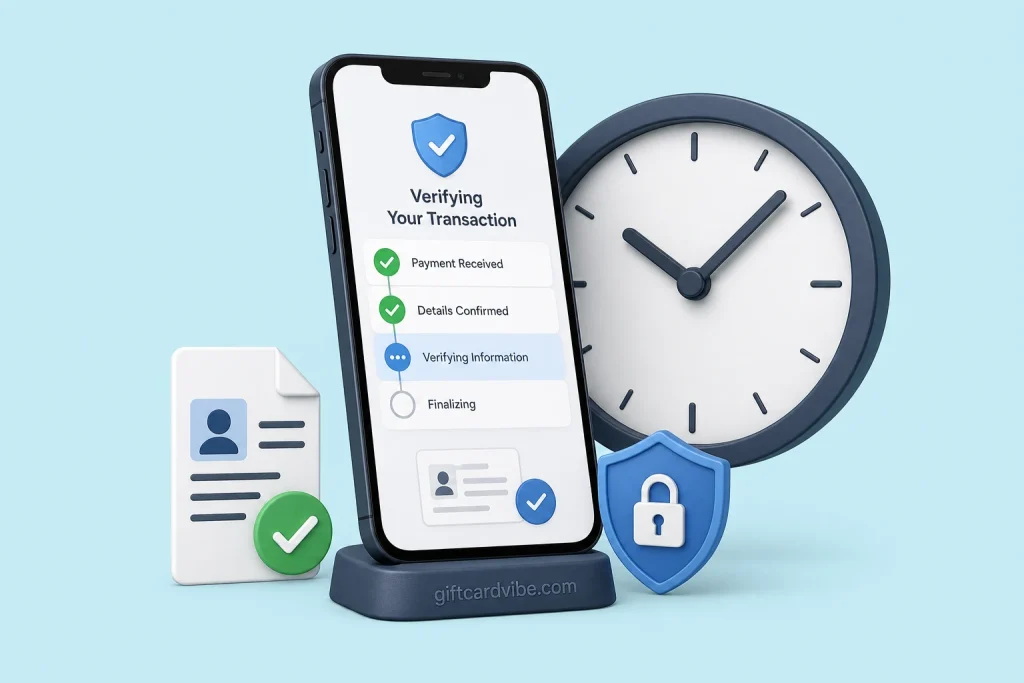
Quick answer: a clean, supported card may receive an initial decision in minutes, but there is no universal five- or fifteen-minute guarantee. Manual review, missing receipt, high value, country mismatch, issuer delays, suspicious account activity, wallet processing, and bank settlement can extend the total time from minutes to hours or longer.
Measure the right stages
| Stage | Starts when | Ends when | Common delay |
|---|---|---|---|
| Queue | Order is submitted | Automated or human review begins | Volume, maintenance, connection retry |
| Card verification | Reviewer receives the evidence | Accepted, modified, rejected, or escalated | Receipt, region, code status, high value |
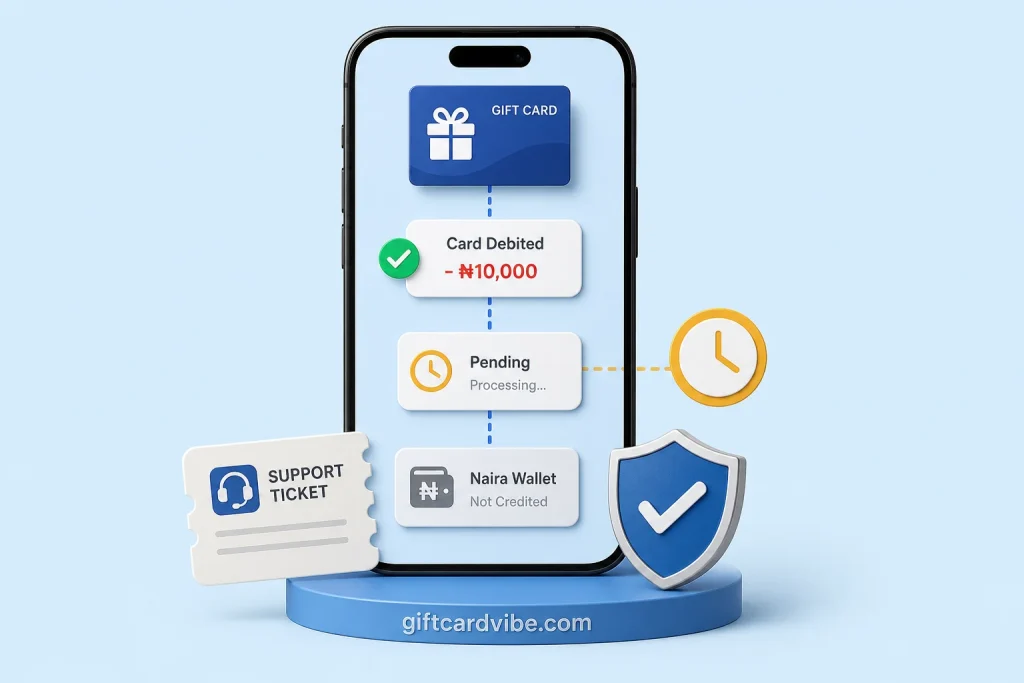
| Wallet credit | Trade is accepted | Naira appears in the app wallet | Internal ledger or compliance hold |
| Withdrawal | User requests payout | Platform sends the transfer | Beneficiary check, limit, payment processor |
| Bank settlement | Transfer is sent | Receiving ledger shows available credit | Bank network, reversal, account restriction |
Why a clean card can be faster
A supported brand and country, exact denomination, intact physical card or original e-code, matching receipt, established verified account, and clear images reduce the questions a reviewer must resolve. A card submitted under the wrong category can be delayed even when the code is valid.
Why manual review is not automatically a scam
Manual review can protect both the platform and seller when an automated rule finds a mismatch. The quality of the process matters: the app should show a status, order reference, evidence request, and official support route. An endless “review” with no ticket, changing fees, or demand for more cards is a red flag.
Create your own service clock
- Record the submission timestamp and order ID.
- Save the advertised or support-stated verification range.
- Record every status change separately.
- Note when wallet credit appears.
- Record withdrawal request, payment reference, and settled bank time.
- Compare the result with the platform’s current published process.
This prevents a bank delay from being misreported as card verification and helps support identify the responsible team.
When to contact support
Contact support when the published window has passed, the status has not changed, a requested document is unclear, the quote changes without explanation, the wallet is not credited after acceptance, or a withdrawal marked paid does not appear at the bank. Use one complete ticket and request the next update time.
Read common statuses correctly
Pending normally means the order is queued. Reviewing means evidence or code status is being checked. Modified should come with a changed attribute or calculation. Completed should lead to a wallet entry, while paid should produce a bank-trace reference. Labels vary, so use the platform’s own definitions and ask when a status has no visible next step.
Take a screenshot when each label changes and file it with the order. A later generic status should not erase the earlier decision or the time already spent in review.
Set a personal escalation threshold
Before trading, write down the published window and when you will open a ticket. For a high-value card, confirm the manual-review path in advance. This prevents panic after five minutes and prevents passive waiting for days when a documented escalation should already have started.
Record weekends, maintenance notices, or bank downtime separately instead of silently extending the platform’s stated review window.
What legitimate support should not request
- A second gift card to accelerate the first order.
- An activation, release, tax, or refundable verification fee.
- Your app password, bank PIN, OTP, or recovery code.
- Remote control of your phone.
- Deleting the original order or chat evidence.
Platform examples and limits
Cardtonic’s current withdrawal FAQ describes typical automatic processing, a pending queue, and a separate path when a paid withdrawal is not visible at the bank. Prestmit’s help centre separates gift card selling, payments, withdrawals, top-ups, and account security. These public processes illustrate why “verification time” and “time until Naira reaches the bank” are different metrics.
How to reduce avoidable delay
Verify KYC and bank details before a time-sensitive trade, use the correct card category, upload complete unedited proof, keep the app updated, and avoid duplicate submissions. For a high-value card, ask about limits and manual review before exposing the code.
Evidence status
- Current evidence
- Published workflow stages and support guidance; not a measured cross-platform timing study.
- First-party timing sample
- Not yet collected.
- Last process check
- Jul 18, 2026
- How to read the article
- Treat durations as process expectations and escalation checkpoints, not a guaranteed benchmark.
Review scope
- Reviewed by
- GiftCardVibe Editorial Desk
- Last fact-check
- Jul 18, 2026
- Scope
- Verification-process review; no first-party timing benchmark has been collected.
Verification time FAQ
Should a legitimate app always verify a card in 5-15 minutes?
No. That can be a fast-path expectation for some cards, not a universal standard or guarantee.
Does manual review mean my card is bad?
No. It means an issue needs additional checks. Ask what evidence or policy applies and keep the order reference.
Is withdrawal time part of card verification?
No. Wallet credit, platform transfer, and receiving-bank settlement are separate stages and should be timed separately.