
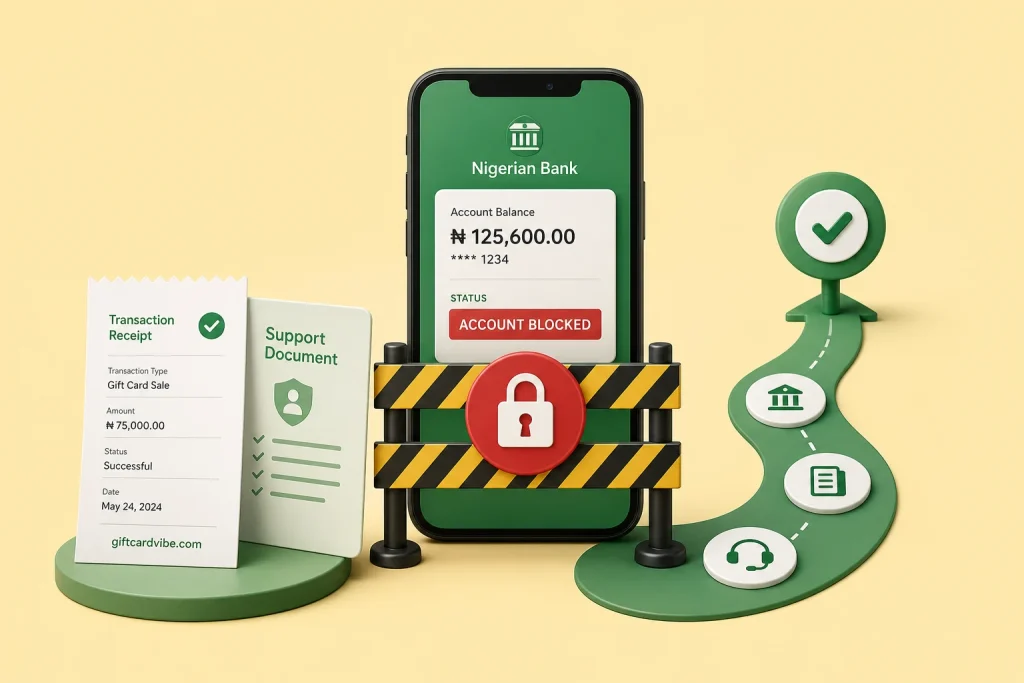
Quick answer: stop moving related funds, preserve the gift card sale and bank records, contact the bank through an official branch or channel, ask for the restriction type and complaint reference, and provide a truthful source-of-funds explanation. If fraud, a law-enforcement request, or a court process is involved, obtain advice from a qualified Nigerian lawyer.
Confirm what “blocked” means
-
App login fails
Possible category: Security or access restriction
Question for the bank: Is the account itself restricted or only digital access?
-
Debit transactions fail
Possible category: Debit restriction, compliance review, or legal hold
Question for the bank: What restriction code and authority apply?
-
One transfer is held
Possible category: Transaction review or beneficiary issue
Question for the bank: Is the whole account affected or only this payment?
-
Credit arrived then disappeared
Possible category: Reversal, recall, or dispute
Question for the bank: What reference and originating institution are involved?
-
Bank requests documents
Possible category: KYC or source-of-funds review
Question for the bank: Which exact documents and secure submission channel are required?
Preserve the full commercial record
- Gift card purchase receipt or lawful source evidence.
- Platform name, official domain, order ID, quote, and card description.
- Accepted status, app wallet entry, withdrawal receipt, and session reference.
- Bank statement showing the incoming payment and later restriction.
- Invoices or client correspondence where the card came from legitimate work.
- Support and bank complaint tickets with dates and names.
Do not create backdated invoices, edit screenshots, or delete uncomfortable messages. A truthful record is essential when the payment may be linked to another person’s fraud report.
Contact the bank first
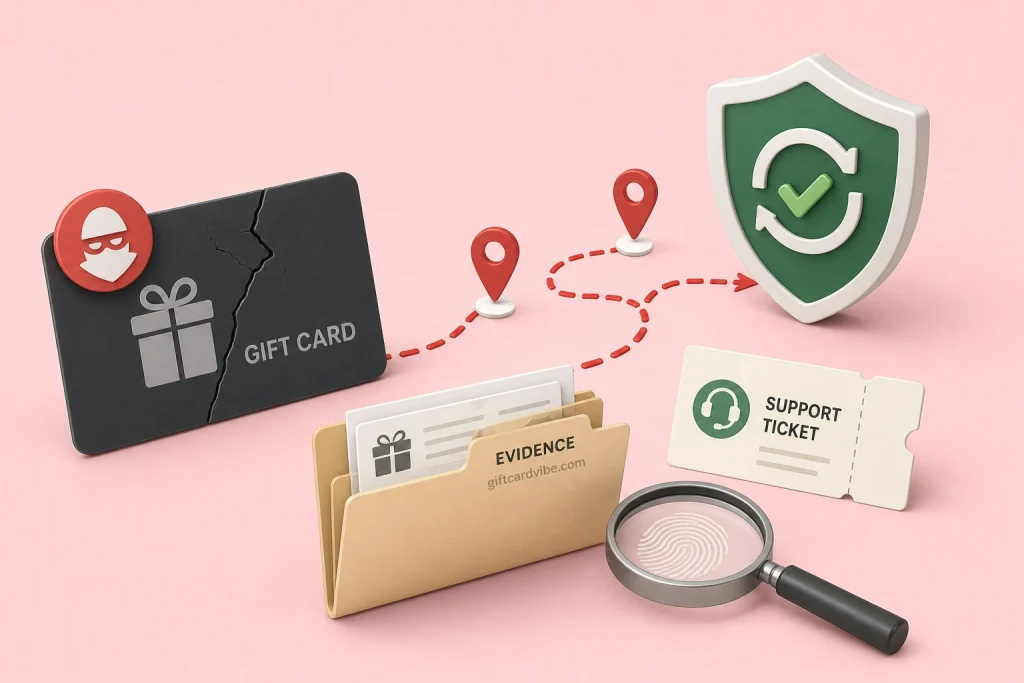
Use the phone number on the bank’s official site or visit a branch with identification. Ask for a written complaint reference and the category of restriction. Request the document list and escalation path. Do not demand confidential details about another customer; focus on what you must provide and what process applies to your account.
CBN complaint guidance says consumers should first complain to the financial institution and may escalate unresolved complaints through the Consumer Protection Department process. Follow the current time requirements and include the bank’s complaint reference.
Questions to put in writing
- Is the restriction on login, debit, one transaction, or the entire account?
- What date did it begin and what internal complaint reference applies?
- Is it based on KYC, a transfer dispute, a regulatory request, or a legal process?
- Which documents can the bank disclose and which documents must you supply?
- What is the next review step and the appropriate escalation contact?
The bank may not be able to reveal another customer’s protected information, but it should still record your complaint and tell you what process governs your account.
Ask for copies of any notices the bank is permitted to provide and keep proof of every document you submit.
Explain the transaction accurately
State that the payment came from a named platform or buyer for a specified gift card transaction, then attach the order record. If a third party paid, say so. Do not describe a private WhatsApp transfer as platform payout when it was not. The mismatch between payer, buyer, and card recipient can be the core issue.
When to involve a lawyer
Seek qualified Nigerian legal advice when the bank refers to a court order, police or agency request, proceeds of crime, multiple disputed transfers, arrest risk, or a prolonged restriction affecting substantial funds. A lawyer can review the actual documents and advise on the correct procedure. Social-media advice cannot replace that case-specific review.
Report platform or payment fraud separately
If the platform misrepresented the payer, diverted funds, or an impostor used stolen money, preserve the evidence and report suspected cybercrime to NPF-NCCC. For a documented consumer-service dispute, review FCCPC. Do not use regulator names as threats; submit a factual complaint to the body with relevant jurisdiction.
Prevent a repeat
- Prefer platform withdrawals from an identifiable business or payment processor.
- Keep personal and business records organised and reconcile every incoming transfer.
- Avoid unexplained third-party payments and private P2P chains.
- Use your own verified bank account with matching identity.
- Test platforms at low value before accepting larger settlements.
- Retain invoices, receipts, order IDs, and withdrawal references.
Review scope
- Reviewed by
- GiftCardVibe Editorial Desk
- Last fact-check
- Jul 18, 2026
- Scope
- Bank complaint-process review; not legal advice about an individual restriction or investigation.
Bank and reporting sources
- CBN consumer complaint management
- CBN consumer rights and education
- NPF-NCCC cybercrime reporting
- FCCPC complaint handling
Blocked bank account FAQ
Can a gift card sale cause a bank restriction?
A related transfer can be reviewed because of a fraud complaint, third-party payment, source-of-funds concern, account mismatch, or other bank or legal process.
Should I contact CBN before my bank?
CBN guidance generally requires complaining to the bank first and retaining its complaint reference before escalation.