
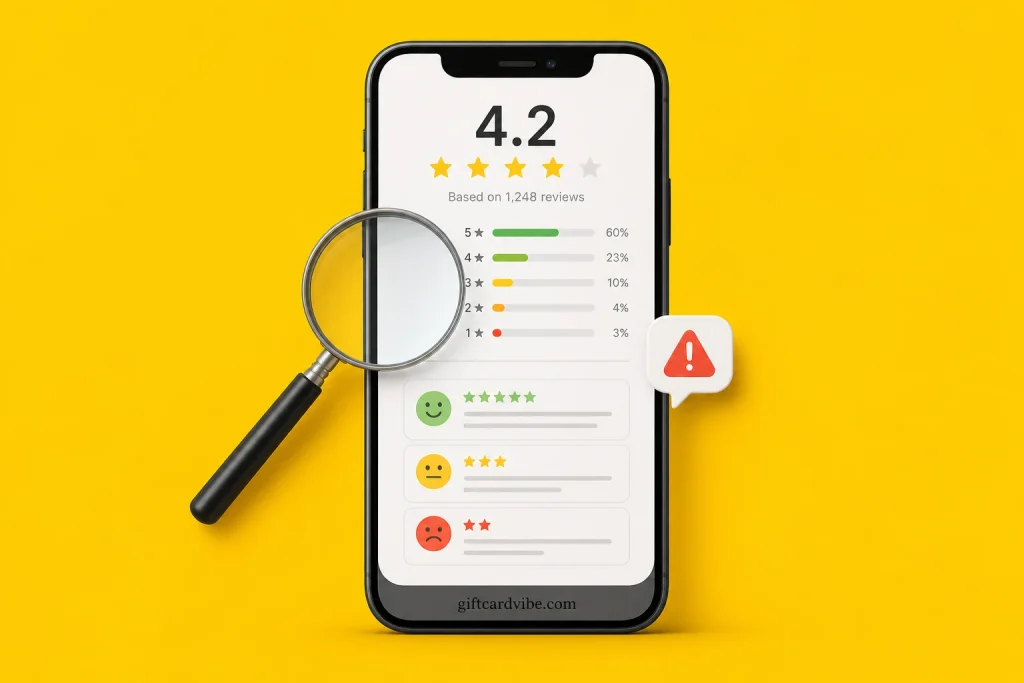
Quick answer: neither a five-star average nor one angry review proves whether a gift card app is safe. Read complaints as incident reports: identify the date, card type, country, amount, order stage, evidence, platform response, and final outcome. Repeated recent failures with the same mechanism matter more than copied praise or an unsupported accusation.
Classify the complaint first
| Complaint type | Evidence to look for | Different question it answers |
|---|---|---|
| Rate changed | Quote time, card country, format, amount, receipt status | Was the estimate clearly conditional? |
| Card marked used or invalid | Issuer status, first attempt time, receipt, order log | Can either side establish the card’s state? |
| Payout delayed | Approved time, withdrawal method, transaction reference | Was the card accepted but money not settled? |
| Account restricted | Verification request, policy cited, appeal outcome | Was the user given a documented review path? |
| Support failure | Ticket number, response times, unresolved questions | Can the company handle exceptions after automation fails? |
Give more weight to useful detail
A credible review usually contains a coherent timeline and details that can be checked without exposing a code. It may include an order reference, redacted status screen, exact product, and an update after resolution. A vague “they stole my card” claim should not be ignored, but it needs follow-up questions before it becomes a factual conclusion.
Likewise, “fast and trusted” repeated across many profiles tells you little. Look for varied language, account history, dates, and descriptions of actual features or transactions.
Check recency and clustering
- Read the newest critical reviews, not only the platform’s featured testimonials.
- Compare reviews around the same app version or date.
- Look for a cluster involving the same withdrawal route, verification step, or card brand.
- Check whether the developer gives specific answers or generic “contact support” replies.
- Return later to see whether reviewers report a resolution.
A short operational outage and a months-long unresolved payout pattern are different risks. Both should be described accurately.
Verify the app before reading its reviews
- Reach the store listing through the company’s official domain.
- Match the developer identity, privacy-policy domain, support address, and app package.
- Review the update date and version notes.
- Never treat a cloned listing or sideloaded APK as the same product.
- Check permissions and account-security options before depositing value.
Build your own small test
Public complaints cannot replace direct due diligence. Test with a low-value card you own, record the quote and terms, submit only through the authenticated order, and verify the settled payout in your own account. Measure support only if you actually need help; do not manufacture a dispute. Repeat later before increasing transaction size because policies and operations change.
Do not convert reviews into fake precision
A public 4.1/5 app score does not justify publishing “4.1/5 safety.” The denominator is unknown, reviews are not a random sample, and the score may reflect unrelated app features. GiftCardVibe’s platform pages therefore separate public identity, policy clarity, test evidence, complaint patterns, and disclosure rather than turning them into an unsupported guarantee.
Escalation evidence matters
If you have a real complaint, write a factual timeline and keep the original card receipt, order record, status screens, support ticket, and payout ledger. Give the company a reasonable official escalation opportunity. Nigerian consumers can consult the FCCPC complaint procedure, which emphasizes accurate information and supporting documents.
A five-minute review check
- Confirm the official app identity.
- Read ten recent detailed reviews across ratings.
- Group complaints by failure type.
- Check platform responses and later updates.
- Read the current terms for your exact card.
- Run a small documented test before a large trade.
Gift card app review FAQ
Does a high app-store rating prove a platform is safe?
No. It is one public signal. It does not disclose transaction volume, card mix, complaint verification, or future performance.
Should I ignore one-star reviews?
No. Read them for specific, repeated failure mechanisms and outcomes. Treat claims as allegations until evidence supports them.
What is the strongest warning pattern?
Recent repeated reports of the same unresolved payout or account-control failure, supported by coherent timelines and weak official responses, deserve close attention.
How often should I re-check a platform?
Before every material increase in value and after policy, app, ownership, or withdrawal changes.