

Quick answer: leave a gift card trading website when its identity cannot be verified, its rates are implausibly high, its policies are copied or missing, support pushes you into private chat, or it asks for a full code before creating an order. A padlock only means the connection is encrypted; it does not prove the operator is honest.
1. The domain does not match the brand
Check every character in the domain. Look for extra hyphens, substituted letters, unusual subdomains, or a login page hosted on an unrelated address. Open the site by typing the address or following the link from the verified app-store developer page, not from an advert or direct message.
A new domain is not automatically fraudulent, and an old domain is not automatically safe. Domain history is context. The stronger question is whether the domain, legal name, app developer, email addresses, and public support channels point to the same operator.
2. The company identity cannot be reconciled
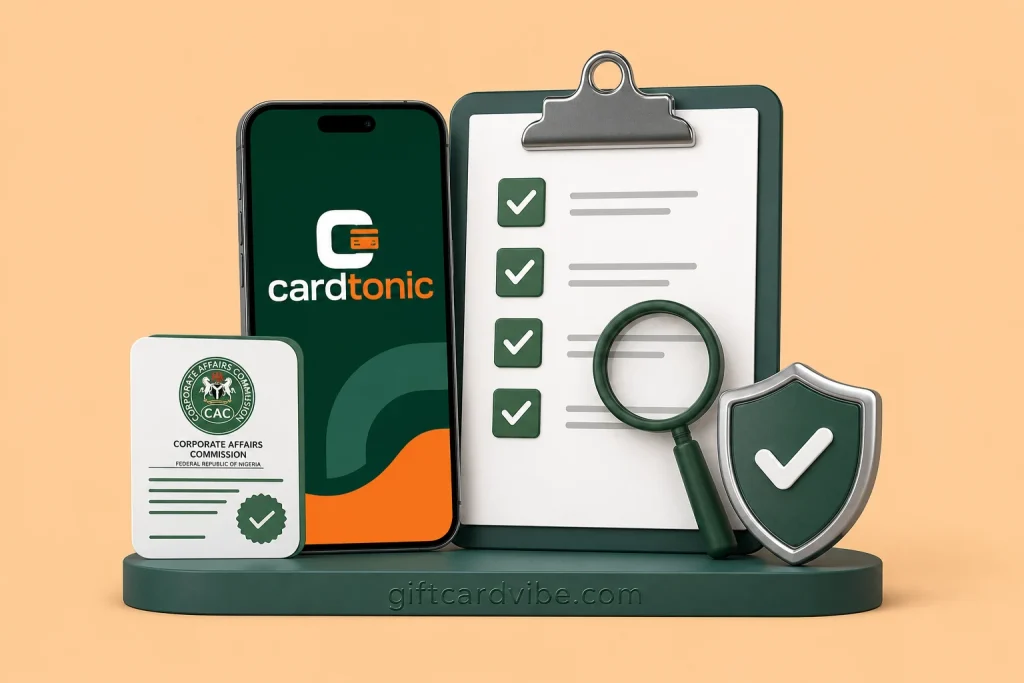
A serious platform should name the operating entity, publish contact routes, and explain its service. Search the legal name or RC number in the CAC public search. Compare status and registered name with the website’s terms and privacy policy.
CAC registration is not a safety certificate. A scammer may impersonate a registered company, and a registered entity can still provide poor service. Treat the record as one identity check and verify that the domain and contact details genuinely belong to the entity.
3. The rate page makes impossible promises
One rate for every country
Why it is weak: Gift card markets and currencies differ.
What a credible page should show: Brand, country, format, amount, and update time.
“Guaranteed highest rate”
Why it is weak: No comparison method or duration is defined.
What a credible page should show: Current quote terms and what can change after review.
Countdown that resets
Why it is weak: Artificial urgency pressures immediate submission.
What a credible page should show: A genuine promotion period with written conditions.
No receipt distinction
Why it is weak: Proof quality often affects review and price.
What a credible page should show: Clear receipt, e-code, physical, and rejection rules.
4. Policies are missing, contradictory, or copied
Read the terms, privacy notice, cancellation rules, prohibited activity, dispute process, and account closure policy. Search a distinctive sentence from the policy. If it appears under another company’s name, the page may be copied. Check whether the legal entity changes between pages or whether contact emails use free mailboxes instead of the company domain.
Plain language matters. A legitimate policy can still be strict, but it should explain who handles the card, when a transaction becomes irreversible, what evidence may be required, and how to complain.
5. Support moves sensitive steps off-platform
- The website’s chat sends you to a personal WhatsApp number.
- An “account manager” requests the code, PIN, OTP, or withdrawal password.
- You are asked to install an APK, browser extension, or remote-support app.
- Support cannot provide a ticket or reference visible inside your account.
- A different person contacts you after every question and gives new bank details.
6. The app evidence does not match
Follow the app link from the official website and compare the developer, privacy link, support address, release history, and reviews. A download button that serves an APK directly deserves additional caution. Store approval does not guarantee every transaction, but a mismatched developer or copied listing is a serious identity problem.
7. The payment flow creates new fees after submission
Stop if a platform demands an activation fee, tax, wallet unlock payment, withdrawal deposit, or “refundable” compliance charge after receiving the code. Credible fees should be disclosed before the irreversible step and reflected in the final calculation. Never send another gift card to release a pending payout.
Use a 10-minute website audit
- Type the domain yourself and inspect spelling.
- Find the legal operator in the terms and search it at CAC.
- Open the official app listing and compare developer details.
- Read privacy, complaint, cancellation, and code-handling rules.
- Ask support one non-sensitive policy question and keep the ticket.
- Compare its exact quote with the rate calculator and two alternatives.
- Check recent detailed complaints, not only testimonials hosted by the platform.
Scam website FAQ
Does HTTPS mean a gift card website is legitimate?
No. HTTPS encrypts the connection. It does not verify the operator’s honesty, trading policy, or ability to pay.
Does CAC registration prove a platform is safe?
No. It helps verify an entity record. You must still confirm the website belongs to that entity and evaluate the actual transaction process.
Is a very high rate always a scam?
Not always, but a rate far outside comparable quotes needs a clear, testable explanation. Never let the number override code custody and identity checks.