
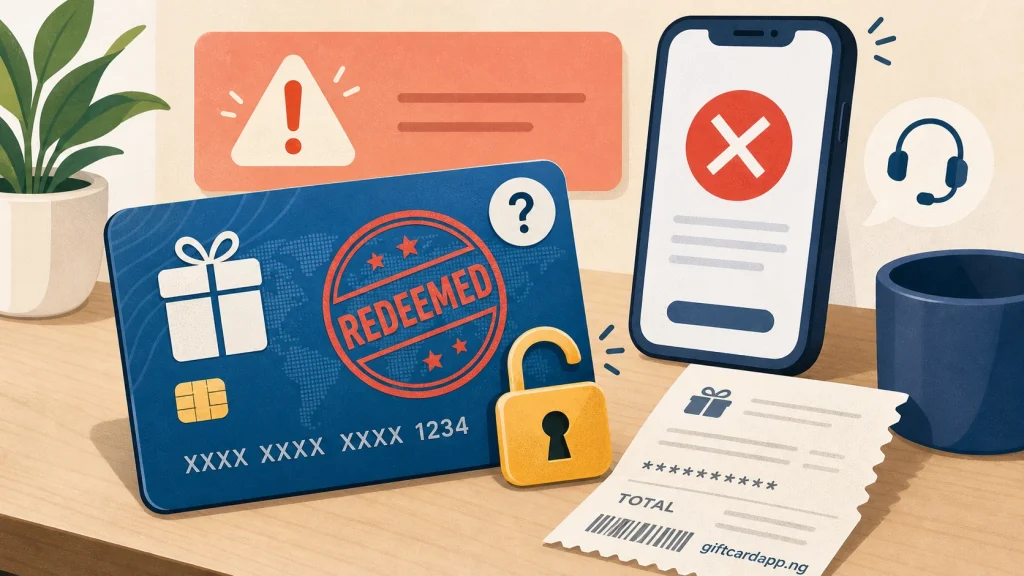
If a gift card says already redeemed, stop retrying the code and collect evidence first. The issue may mean the card was used, entered into the wrong account, partially applied, region-blocked, or incorrectly flagged. The next step depends on receipt proof and official support evidence.
What “already redeemed” can mean
| Possible cause | Evidence to collect | Likely trading impact |
|---|---|---|
| Actually used | Account history, balance check, seller messages | Usually rejected |
| Wrong account or region | Account country, error screenshot, card country | Manual review possible |
| Activation problem | Original receipt and activation line | Official support case needed |
| Typing/photo error | Clear card image and code verification | May be fixable |
| Partial use | Balance history or official balance page | Discount or rejection |
Why repeated attempts are risky
Repeatedly entering a code can make the case harder to explain. Some brands may flag unusual attempts. A trading platform may also become more cautious if the error history looks messy. Stop, screenshot the exact error, and organize proof.
How this affects rate
A clean card can use the normal rate range. A card with an already-redeemed warning may fall to a low estimate, be paused for manual review, or be rejected completely. Hiding the problem usually makes the outcome worse.
Safe troubleshooting steps
- Take a screenshot of the exact error.
- Check whether you used the correct region/account.
- Collect receipt and activation proof.
- Check official support or balance route if available.
- Tell the platform about the issue before submission.
When to contact official support
Contact official support when you have receipt proof and the card should be valid. Provide purchase date, activation proof, card country, and the exact error. Do not send the full code through public channels.
Steam already redeemed Amazon invalid code All rates Calculator Price system Platform list Scam Radar
Official issuer context
eBay explains account linking, checkout and refunds in its official gift card help.
FAQ
Can an already redeemed card be fixed?
Sometimes, if the issue is region, account, activation or support-related. Truly used cards are usually rejected.
Should I trade it anyway?
Only disclose the issue and expect lower rate or manual review.
Why should I stop retrying?
Repeated attempts can complicate support review and make the case look suspicious.
What proof matters most?
Original receipt, activation line, exact error screenshot and account/region details.
How users accidentally make the error worse
Many users panic and try the code again on different accounts or send it to multiple buyers to “check.” That can make the history look suspicious. If the card was only region-blocked or temporarily misread, repeated attempts may still reduce trust. Treat the first error as a signal to pause and document.
What to tell a platform
Do not hide the error. A better message is: “This card showed an already-redeemed warning when checked. I have the original receipt and screenshot of the error. Can you review whether this brand and region are supported?” That gives support a clear starting point and protects you from being accused of submitting a clean card dishonestly.
When the card may be unsellable
If official support confirms the card was redeemed, or if there is no receipt, no source proof, and no balance evidence, the card may not be tradeable. In that case, chasing another vendor often creates more risk than value.
What not to do after the error
Do not send the same code to multiple vendors for “confirmation.” If one vendor tries to redeem it, another may later say it is already used, and the timeline becomes impossible to prove. Do not delete the original client or purchase messages. Do not crop the error screenshot so tightly that account country, time, or support context disappears. The goal is to preserve a clean evidence trail.
When to use a lower estimate
If a card has shown an already-redeemed warning once, use the low estimate until the issue is explained. This keeps expectations realistic and prevents you from choosing a platform only because it advertises the highest clean-card rate.