
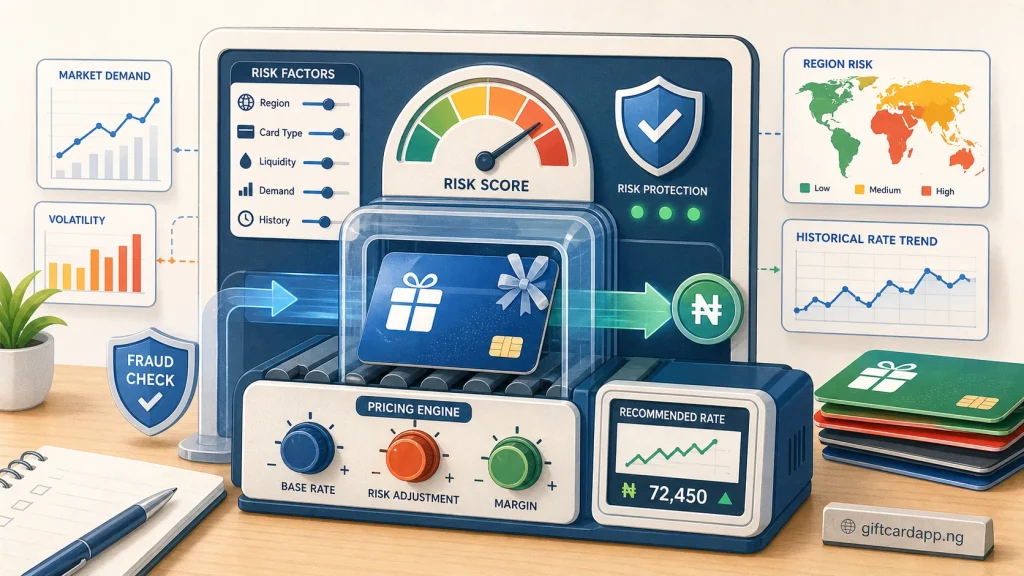
Gift card platforms price more than the code value. They price the chance that the card fails, gets disputed, belongs to the wrong region, needs support review, or cannot be processed quickly. This risk layer is why two cards with the same USD value may receive different Naira payouts.
The platform's hidden checklist
| Risk layer | Question a platform asks | How it affects payout |
|---|---|---|
| Brand demand | Can we process or resell this brand quickly? | High demand may improve rate |
| Proof quality | Can the user prove purchase and activation? | Weak proof can reduce rate |
| Redeem risk | Does this brand often trigger errors or disputes? | More errors mean lower confidence |
| Support load | Will this trade need human review? | Manual review can delay payout |
| Complaint pattern | Are many users reporting issues with this route? | Platform may become more conservative |
Why receipt questions are normal
A receipt does not guarantee payment, but it gives the platform evidence. If a card later fails or is disputed, the platform can use receipt details, activation proof, date, and store information to evaluate the case. Without proof, the platform carries more uncertainty.
Why very high private quotes are suspicious
A platform usually needs a spread to cover risk and processing. A private vendor who offers a rate far above the market may be legitimate, but the trader should ask: how will I dispute this if payment does not arrive? If the answer is “you cannot,” the high rate may not be worth it.
How this affects users
Users should stop thinking only in terms of “highest rate.” A better question is: does this platform show final rate clearly, explain receipt handling, provide support history, and keep a transaction record?
Signals of a healthier platform flow
- Rate is shown before code submission.
- Card type and receipt rules are visible.
- There is a transaction ID or dashboard.
- Support explains delays instead of disappearing.
- The platform warns users not to send codes through impersonator accounts.
WhatsApp vendor risk All rates Calculator Price system Platform list Scam Radar
FAQ
Do platforms lower rates just for profit?
Platforms need margin, but legitimate pricing also reflects fraud risk, support cost, liquidity and buyer demand.
Why do high-risk cards pay less?
They are more likely to need manual review, fail redemption, or become disputed.
What is the safest platform signal?
Clear final payout terms before code submission and a traceable support path.
Can risk pricing change daily?
Yes. Demand, complaint patterns and liquidity can change quickly.
What review teams are trying to prevent
A platform wants to avoid paying for a card that later fails, gets reversed, triggers a dispute, or cannot be used by the downstream buyer. This is why support teams ask questions that may feel repetitive: receipt, region, source, amount, card type, and screenshots. Those checks are not only bureaucracy; they protect the payout process.
Why delay is not always scam behavior
One mistake traders make is treating every delay as fraud. A delay can be bad support, low liquidity, manual review, or actual scam behavior. The difference is evidence. A platform with a ticket, transaction ID, and clear explanation is different from a private vendor who disappears after receiving a code. Scam Radar pages should explain that distinction carefully.
How users can reduce risk before submission
Users can help themselves by preparing evidence before the platform asks. Keep receipt photos readable, keep account-region details, avoid sending codes to multiple vendors, and do not crop screenshots until the platform tells you what to hide. A cleaner submission can mean fewer support loops.
Risk pricing is not personal
Users sometimes feel insulted when a platform asks for proof or lowers a quote. In most cases, the platform is not judging the user personally; it is judging the transaction evidence. A clean user can still submit a risky-looking card if the receipt is missing, region is unclear, or the code has already been exposed.
Better user mindset
Think like a reviewer before submission. Ask whether a stranger could understand the card's source from your evidence. If not, prepare more context before expecting the best rate.