
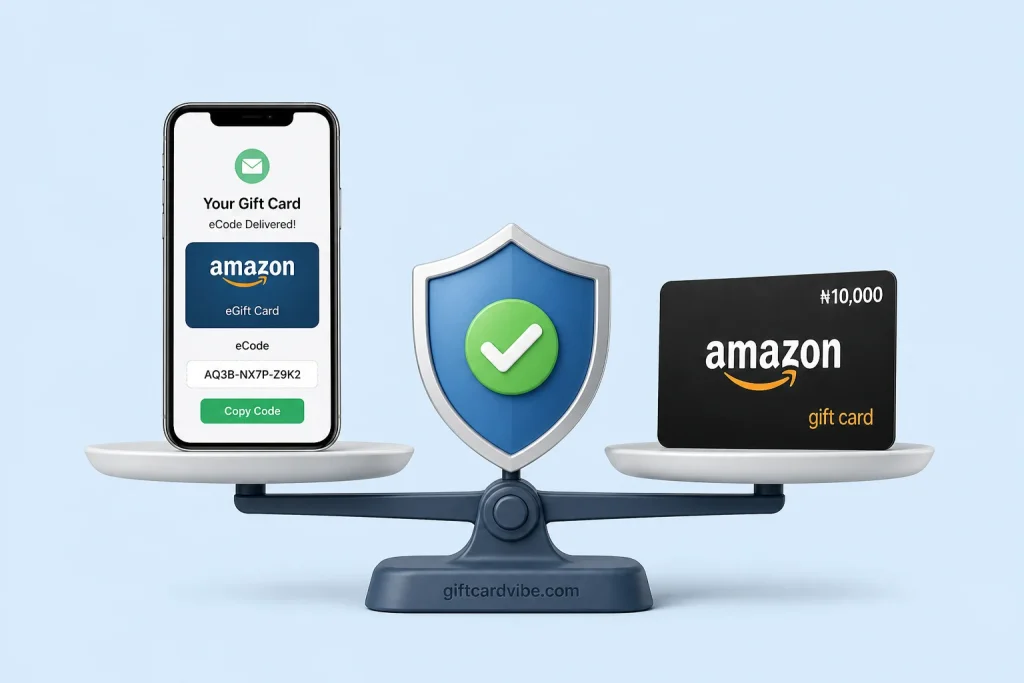
Quick answer: an e-code is safe to sell only when its origin, country, value, and custody can be documented and the code stays inside one authenticated order. Unlike a physical card, the same digital code can be copied perfectly and forwarded without visible damage, so screenshots, email security, and one-platform-at-a-time submission are essential.
E-code and physical card risks are different
| Issue | E-code | Physical card |
|---|---|---|
| Copying | Can be duplicated instantly without visible evidence | Usually requires seeing or photographing the scratched code |
| Proof | Original delivery email, retailer order, sender, timestamp | Card, packaging, sales and activation receipt |
| Country | Often shown in retailer domain, currency, or email terms | Shown on packaging, card terms, currency, and receipt |
| Custody | Email, cloud, clipboard, chat, and device access matter | Physical access and image-sharing history matter |
| Dispute | Exact delivery and forwarding timeline is crucial | Card serial, receipt, and physical custody are crucial |
Secure the source email first
Change a reused or weak email password, enable two-factor authentication, review recent sessions, remove unknown forwarding rules, and confirm recovery details. A compromised mailbox can expose the code before the trading platform ever sees it. Do the same for the retailer account that issued the e-code.
Save the original email file or full header where possible. A cropped screenshot may omit the sender domain, date, order number, currency, and delivery path needed to verify origin.
Classify the e-code accurately
- Confirm the brand and exact product, such as Apple gift card versus Apple Store product.
- Identify the issuing country and currency from the retailer and terms.
- Record the denomination and whether it is fixed or variable value.
- Confirm whether it was purchased directly, received as a gift, or paid by a client.
- Disclose whether the code has been forwarded, screenshotted, or submitted before.
Do not compare an e-code quote with the highest physical-card row. Open the dedicated brand page and use the matching market and type. The difference is not merely cosmetic; the buyer is pricing a different evidence and fraud profile.
Create a controlled submission record
- Choose one platform and create an order before revealing the code.
- Save the quote, order ID, exact upload time, and code status.
- Upload through the official app or HTTPS domain, not a support agent’s private chat.
- Do not keep the code in a shared clipboard manager or public notes app.
- Do not submit the same code to another platform while the first order is open.
- After completion, retain evidence but store sensitive files in a protected location.
What a platform may ask for
A platform may request the original purchase email, order page, payment evidence, sender information, or client invoice. Redact unrelated personal data while leaving the fields needed to match the card. Ask why each item is needed and review the platform’s privacy notice before sending identity documents.
If the e-code is rejected as already used
Stop all submissions. Check the issuer account you control, secure the delivery email, and build a timeline from purchase to the first error. Include every recipient and platform. Contact the issuer with the original order evidence and the first observed error. A digital code has no scratch panel to reveal when copying occurred, so precise timestamps are your strongest evidence.
When an overseas client pays by e-code
Agree on the brand, country, amount, delivery address, and lawful source before work begins. Keep the invoice and the client’s original retailer confirmation. Do not let the client buy a region you cannot use or safely trade. If a new client insists on an obscure code, refuses an invoice, or forwards a code bought by someone else, pause the payment rather than inheriting an unverifiable custody chain.
Which format is safer?
Neither format is automatically safe. A sealed physical card with a clean activation receipt usually has clearer custody. An e-code bought directly from an official retailer into a secured email can also have strong evidence. The highest-risk card is the one with an unclear source, many recipients, and no reliable timeline.
Related guides
Read why physical and e-code rates differ, compare exact country rows in the price system, and review the complete selling workflow.
Format and custody references
- Apple official gift card redemption methods
- Google Play gift card country rules
- Steam Wallet official guidance
E-code trading FAQ
Do e-codes always pay less than physical cards?
No. The rate depends on brand, market, denomination, demand, and platform controls, but e-codes often carry a different custody risk.
Can I send a screenshot with part of the code hidden?
For classification, send only non-sensitive proof requested by the official platform. Do not expose enough of the code to reconstruct it.