
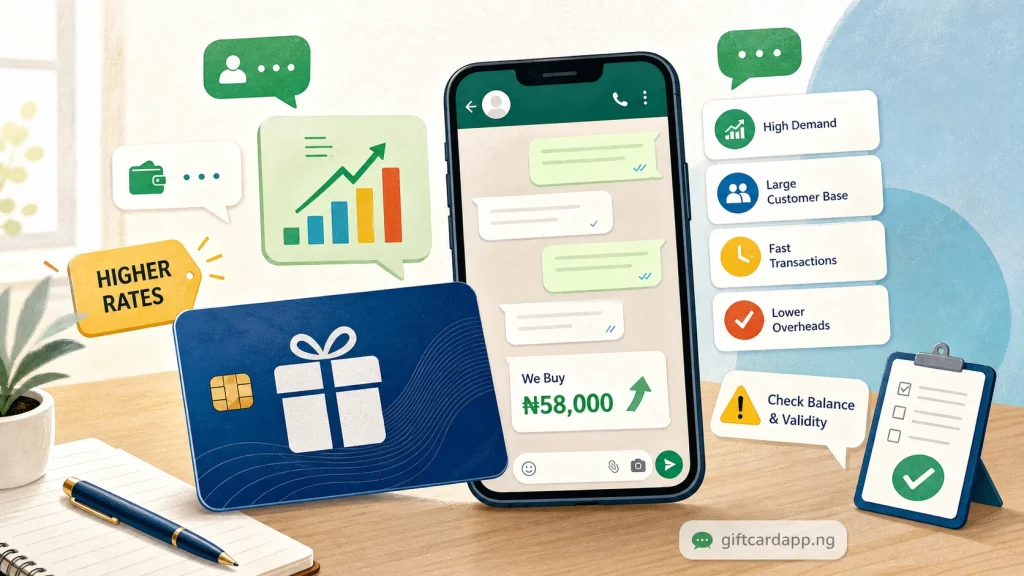
WhatsApp gift card vendors often offer higher rates because they are private and less structured than apps. Some may be genuine small traders, but the seller carries more risk when there is no public platform, transaction ID, support trail, or reliable dispute process.
Why the quote can look better
A private vendor may have a direct buyer for one card type, lower overhead, or simply use a high number to attract sellers. The problem is that a quote is not the same as a completed payout. Once you send the code, your leverage drops sharply.
| Vendor claim | Possible honest meaning | Risk question to ask |
|---|---|---|
| “I pay above app rate” | Vendor has a buyer ready today | Can they show a real payout path? |
| “Send code first” | Vendor wants to verify before payment | What happens if they vanish? |
| “Payment screenshot sent” | Transfer may be pending | Has money actually landed? |
| “Rate expires in 5 minutes” | Market demand may change | Is this pressure tactic? |
| “No receipt needed” | Vendor accepts more risk | Will they later use no receipt as excuse? |
The most common danger
The danger is not only “fake vendor.” It is also no process. If a platform delays a payout, you may have ticket history, transaction ID, and support messages. If a private vendor delays, blocks you, or claims the code failed, your evidence may be limited to chat screenshots.
How scammers use high rates
A scammer can quote above-market rates because they do not plan to pay. They may send edited payment proof, claim bank delay, ask for another card to “unlock” payment, or say the card was already used after receiving the code.
Safer private-trade checklist
- Never send the full code before clear final payout terms.
- Do not accept screenshot-only proof of transfer.
- Check whether the buyer has a real business identity.
- Start with a small test only if you accept the risk.
- Use a platform for high-value cards.
Fake screenshot guide Code-first warning All rates Calculator Price system Platform list Scam Radar
Consumer protection source
The FTC gift card scam guide explains why urgency and requests for card numbers are high-risk signals.
FAQ
Are all WhatsApp vendors scams?
No. But private trading has higher evidence and dispute risk.
What is the biggest red flag?
Pressure to send the full code before verified payment or traceable support.
Why do apps sometimes pay less?
Apps price support, fraud review, liquidity and transaction records into the quote.
Should beginners use WhatsApp vendors?
Beginners should be very cautious and usually start with traceable platform flows.
Why private trading feels tempting
Private vendors are attractive because the conversation is quick and the quoted number may be higher than an app. For a trader who needs cash urgently, that can feel like the best option. The problem is that urgency makes people skip evidence checks. Scammers know this and use speed, scarcity, and high rates to push sellers into sending the code first.
How to compare a vendor with a platform
Do not compare only the rate. Compare the whole route: final quote clarity, identity, support path, transaction record, payment confirmation, and what happens if the card is disputed. A platform can still have complaints, but at least there may be a process. A private chat can disappear instantly.
Safer wording to use with vendors
Before sending anything, ask: “What is the final Naira payout for this exact brand, country, amount, and receipt status?” If the answer is vague or the vendor says “send first,” slow down. A serious buyer should be able to state terms before collecting irreversible card details.
Payment proof should be bank proof, not image proof
A screenshot is easy to fake. A safer signal is money actually landing in your account or wallet, with a reference you can verify independently. If the vendor says payment is “pending,” the card should not be considered paid. This is especially important for high-value Apple, Steam, Razer Gold, or Amazon cards where one mistake can wipe out a week of income.
Impersonation risk
Some scammers copy names, logos, or profile pictures from real platforms. Always verify the official domain or app path before trusting a chat account.