
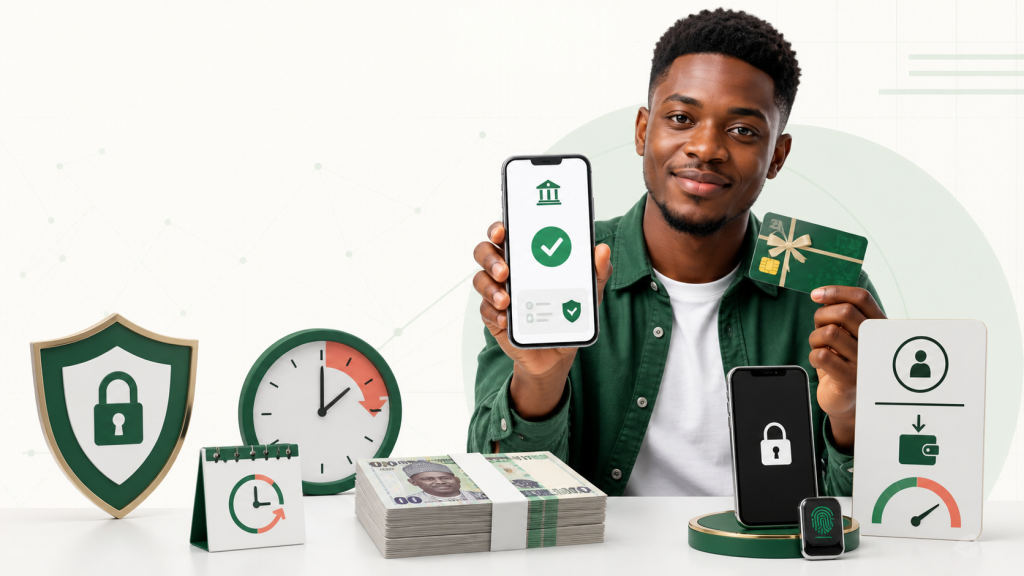
According to the Central Bank of Nigeria’s official reforms page, instant-payment standards that took effect on 1 July 2026 added stronger controls around mobile banking, device changes and fraud monitoring. For a gift card seller, the important distinction is simple: a trading platform can approve a naira payout while your bank still controls what you can do with the money after it reaches your account.
The CBN summary does not set gift card rates, add a tax to gift card sales or state that incoming payouts are capped. It does describe a temporary transaction limit on a newly activated mobile-banking device, which can explain why a seller sees a credit but cannot immediately move the full balance.
What the CBN rule says
The CBN’s official reforms page says the guidance was contained in a circular dated 12 March 2026 and that the standards took effect on 1 July 2026. The same summary says financial institutions must strengthen identity checks and real-time fraud monitoring for instant payments.
The parts most relevant to everyday account holders are:
| New control | What it means in practice | Why a gift card seller should care |
|---|---|---|
| One mobile device at a time | A mobile banking app may be linked to only one device | Activating the app on a replacement phone can trigger a fresh security window |
| Temporary new-device limit | The CBN summary says a banking app activated on a new device carries a temporary ₦20,000 transaction limit for the first 24 hours | You may see the payout in your balance but be unable to move the full amount immediately |
| Customer-set lower limits | Customers can choose a lower personal instant-transfer limit, subject to verification and risk assessment | A forgotten self-imposed limit can look like a platform payout problem |
| Instant-payment opt-out | A customer can voluntarily disable instant transfers, with multi-factor authentication protecting the change | Incoming funds and outgoing instant transfers may behave differently |
| Real-time fraud monitoring | Banks and payment providers must strengthen monitoring and identity checks | Unusual device, location or transaction behaviour may lead to additional review |
Read the CBN Reforms and Initiatives page for the official summary. The CBN also maintains a broader Payments System Supervision page describing its work on payment security and fraud prevention.
A payout has four separate stages
Many disputes become confusing because the seller, trading app and bank use the word “paid” for different events. Treat a gift card transaction as four separate stages:
- Card verification: the platform checks the card, country, denomination, receipt and code status.
- Payout approval: the platform accepts the trade and creates a naira payout instruction.
- Bank credit: the receiving bank posts the money to the account balance.
- Funds movement: the account holder transfers, withdraws or spends the credited money.
The CBN’s new-device control mainly affects stage four. It should not be used by a trading platform as a vague excuse for a trade that is still stuck at stage one or two.
If the platform accepted your card but no naira payment was created, follow the evidence steps in Gift Card Accepted but No Naira Payout: What to Do. If the bank account itself becomes restricted, use the separate guide on what to do when a Nigerian bank account is blocked after a gift card sale.
Payout status decoder
Use the status you can actually prove, rather than guessing which company is responsible.
| What you can see | Most likely stage | First action |
|---|---|---|
| Card submitted, no acceptance notice | Platform verification | Ask for the trade reference and review status |
| Platform says paid, no bank credit or transfer reference | Payout instruction | Request the bank transfer reference from the platform |
| Transfer reference exists, no credit in your account | Bank/payment rail | Give the reference and exact time to your bank |
| Money is visible, but a transfer above ₦20,000 fails after activating a new phone | New-device security window | Check the activation time and your bank’s current limit notice |
| Money is visible, but all account activity is restricted | Account review | Contact the bank’s fraud or complaints team; do not pay an unofficial “unlock” fee |
| Platform asks you to send another card to release the first payout | High-risk conduct | Stop the transaction and preserve all evidence |
This table is a diagnostic guide, not a guarantee. Banks implement customer-facing messages differently, and a failed transfer can have causes unrelated to the July 2026 rule.
What to do before changing phones
A phone replacement is now part of payout planning, especially when you expect a high-value gift card sale.
- Complete urgent outgoing transfers before moving the banking app, if your bank permits it.
- Record the exact time the banking app is activated on the new device.
- Check whether your bank displays a temporary transaction cap or cooling-off period.
- Confirm that your BVN-linked details and registered phone number are current through official bank channels.
- Avoid scheduling a large card trade during the same hour as a device change.
- Keep enough time for platform verification and the bank’s security window; they are separate processes.
The CBN reforms page states a 24-hour window for the temporary ₦20,000 new-device limit. Your bank may add its own authentication steps, so rely on the notice inside the official app or a verified bank support channel for the exact restoration process.
Example: selling a high-value card after a phone switch
Suppose a seller activates mobile banking on a new phone at 2:00 p.m. and later sells a high-value card. The platform verifies the card, and the naira payout appears in the account at 6:00 p.m.
The correct response is not to accuse the platform immediately if the balance is already credited. First check whether the bank is limiting outgoing transactions on that newly activated device. Do not send a second card, reveal an OTP or pay a stranger to “remove” the limit.
A safer sequence is:
- Confirm the payout in the bank’s own transaction history, not only through an SMS alert.
- Save the platform trade reference and bank credit reference.
- Read the in-app security notice and identify when the 24-hour window ends.
- Contact the bank through the number or secure chat shown in its official app if the message is unclear.
- Escalate only if the limit remains after the stated window or the account shows another restriction.
Before accepting any quote, use the GiftCardVibe rate calculator and then compare the card’s country, type, denomination and receipt status on the Nigeria gift card rates hub. The live rate estimate and the bank’s transfer limit answer two different questions.
Evidence to keep when a payout is delayed
Build one small evidence folder for the transaction. It should contain:
- the trading platform’s trade ID;
- the platform status and payout timestamp;
- the bank transfer reference, if one exists;
- a redacted bank statement or transaction-history screenshot;
- the exact error message shown by the banking app;
- the date and time the device was activated;
- support ticket numbers and responses.
Hide the gift card code, banking password, PIN, OTP and full account credentials. A legitimate support agent can investigate a transfer using references and account verification procedures; they should not need your gift card code through WhatsApp or a public comment.
For identity-check questions, read why gift card apps request BVN or NIN verification. KYC can be legitimate, but documents should only be submitted through a verified platform channel with a clear privacy notice.
Who should resolve each problem?
Contact the gift card platform when the card remains under review, the payout has not been approved, or the platform cannot provide a transfer reference. The guide on normal gift card verification time can help you separate a routine check from an unexplained delay.
Contact the bank or payment provider when the transfer reference exists but the credit is missing, when funds are visible but unavailable, or when a new-device restriction persists beyond the stated period.
The CBN’s Complaints Management page says customers should first lodge the complaint with their financial institution and keep evidence of that complaint. If the institution does not resolve it through the applicable process, the page explains how to escalate to the CBN Consumer Protection Department.
What the rule does not prove
The new instant-payment controls do not prove that a gift card platform is safe. They also do not validate a private WhatsApp buyer, guarantee recovery from a scam, determine the exchange rate, or justify a request for a second card.
Assess the platform separately. Check its public company information, payout terms, complaint history, privacy controls and support channels. The GiftCardVibe Legit List explains the criteria we use, our limitations and any disclosed relationship.
Frequently asked questions
Does the ₦20,000 new-device limit reduce the amount I can receive?
The CBN summary describes a temporary transaction limit on a newly activated mobile-banking device; it does not state that incoming credits are capped. If the full credit is visible but you cannot move it, confirm the restriction with your bank.
Can a gift card app blame CBN for every delayed payout?
No. Ask which stage is delayed. A platform should be able to distinguish card verification, payout approval and transfer initiation. CBN controls do not replace the platform’s duty to provide a clear transaction status.
Should I send my OTP to support so they can remove the limit?
No. Do not disclose an OTP, PIN or password. Use the bank’s official app, website, branch or verified customer-service number.
Bottom line
The instant-payment standards that the CBN says took effect in July 2026 add useful fraud controls, but they make transaction status more important. A seller should verify whether the card is approved, whether the payout was initiated, whether the bank credited it and whether the funds can be moved. Those are four different facts.
When a device has just changed, plan around the temporary security window, keep clean evidence and use official support channels. That is more reliable than accepting a vague “CBN delay” explanation from either a platform or an anonymous buyer.