
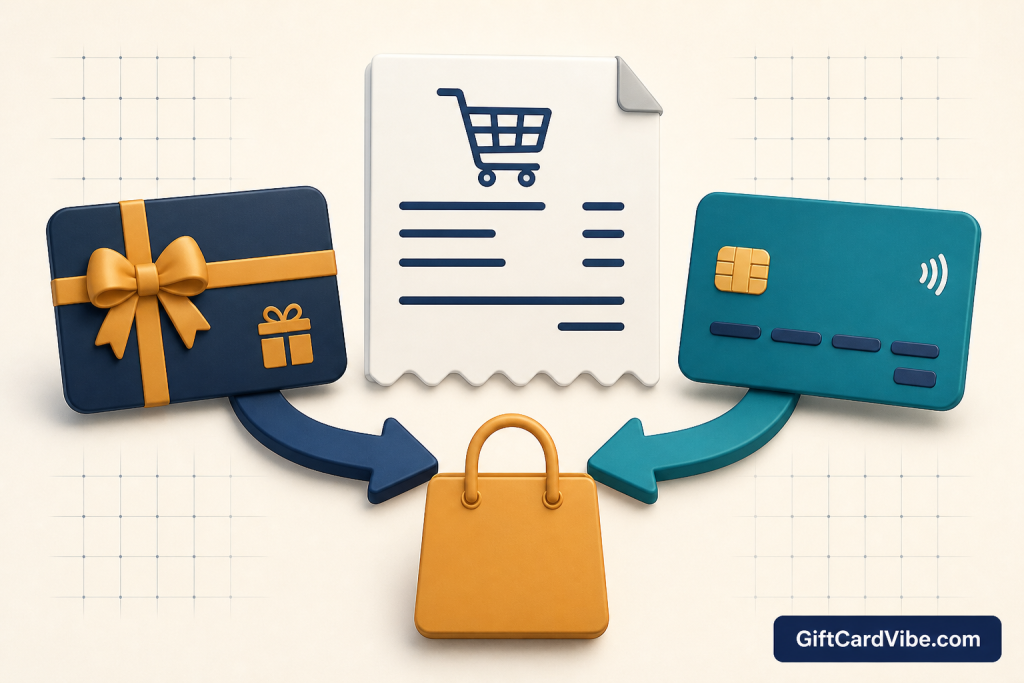
Some merchants allow a gift card to cover part of a purchase and another payment method to cover the rest. Others require enough gift balance for the full order, limit which payment methods can be combined, or handle subscriptions and taxes differently. Check the merchant’s checkout rules before redeeming or spending the card.
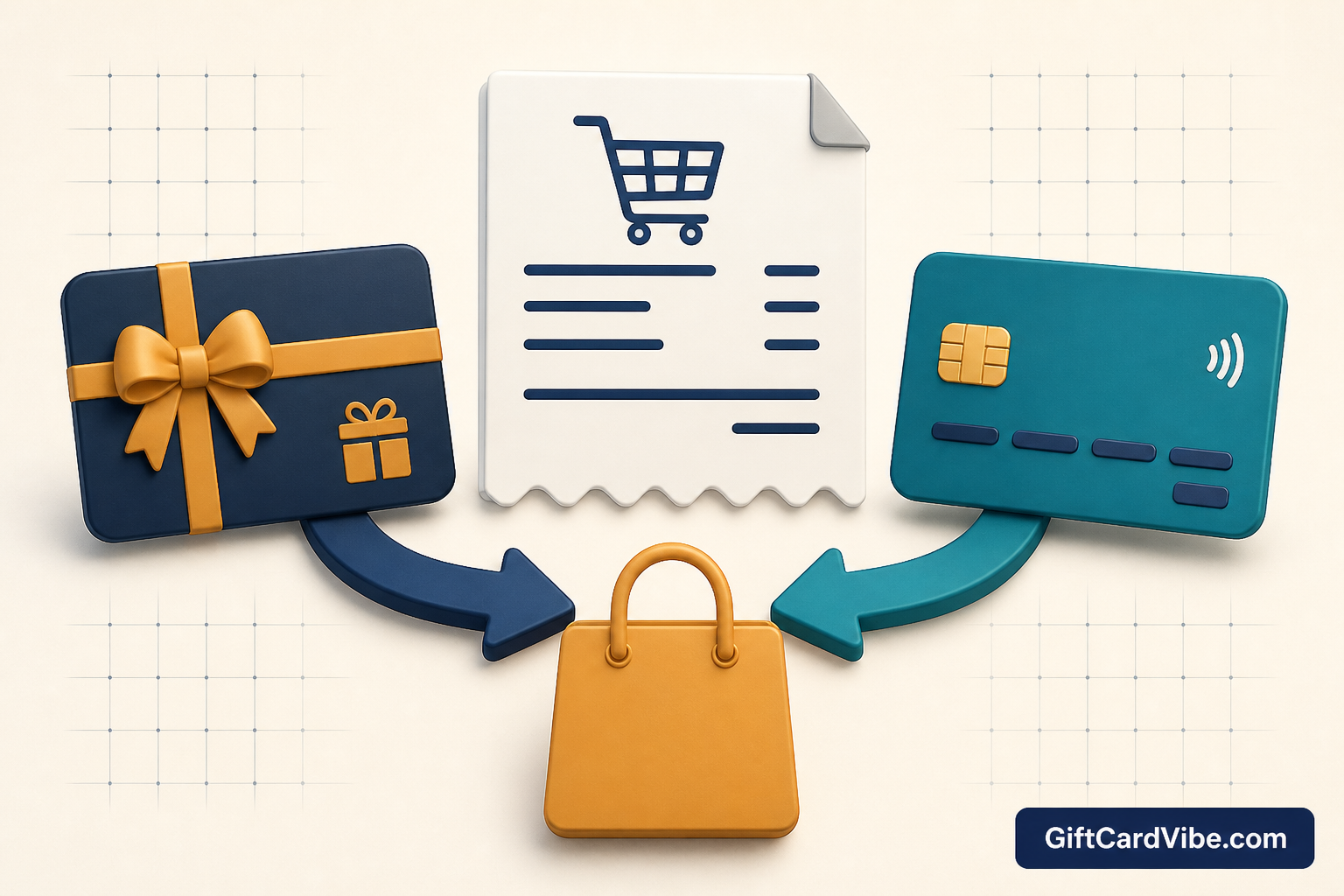
Split tender in plain language
If an order costs $70 and a gift card has a settled $50 balance, a supported checkout might use $50 from the gift card and $20 from a debit card. The merchant records two payment sources for one purchase.
Support is not universal. Google Play says users can combine Play balance with another payment method when the balance is below the purchase amount, subject to limitations. That is a Google Play rule, not proof that every brand works the same way.
Check these five details before paying
Order type. Subscriptions, pre-orders, marketplace sellers, and digital goods may use different rules from normal merchandise.
Taxes and fees. A gift balance that covers the item price may still be short after tax or delivery.
Payment priority. Confirm which source will be charged first and whether you can edit the amounts.
Refund routing. A returned split-tender order may be credited back across the original sources rather than entirely to cash or bank.
Pending authorizations. General-use prepaid cards can temporarily show holds that differ from the final settled amount.
What happens to the remaining balance?
If the gift card is not fully used, the remainder normally stays under the issuer’s terms. Record the settled result through the official balance tool. Do not estimate it by subtracting the shelf price alone; tax, partial captures, cancellations, and refunds can change the ledger.
Why this matters before trading
A card used in split tender is no longer safely described by its original denomination. Wait for the transaction to settle, verify the remaining balance, and disclose that it is partially used. Some trading platforms reject partial cards even when value remains.
Our guide on partially used gift cards explains the evidence and acceptance questions.
Refund example
Suppose a $90 order used $60 in gift balance and $30 from a bank card. A later $20 refund might not go entirely to the bank card. The merchant’s policy and transaction allocation determine the destination. Keep the original card and both payment records until every credit settles.
If a support agent says a refund was issued but your balance has not changed, follow the sequence in Where Does a Gift Card Refund Go?. Do not pay a third party to release it.
A safer checkout routine
- Check the exact gift balance through the issuer.
- Read the merchant’s accepted payment combinations.
- Confirm the final total including tax and delivery.
- Save the order breakdown and payment allocation.
- Keep the gift card until refunds and holds are settled.
Bottom line
Split payment is a merchant feature, not a universal gift-card right. Verify support before checkout, preserve the payment breakdown, and treat any remaining value as a partial balance rather than the original face value.