
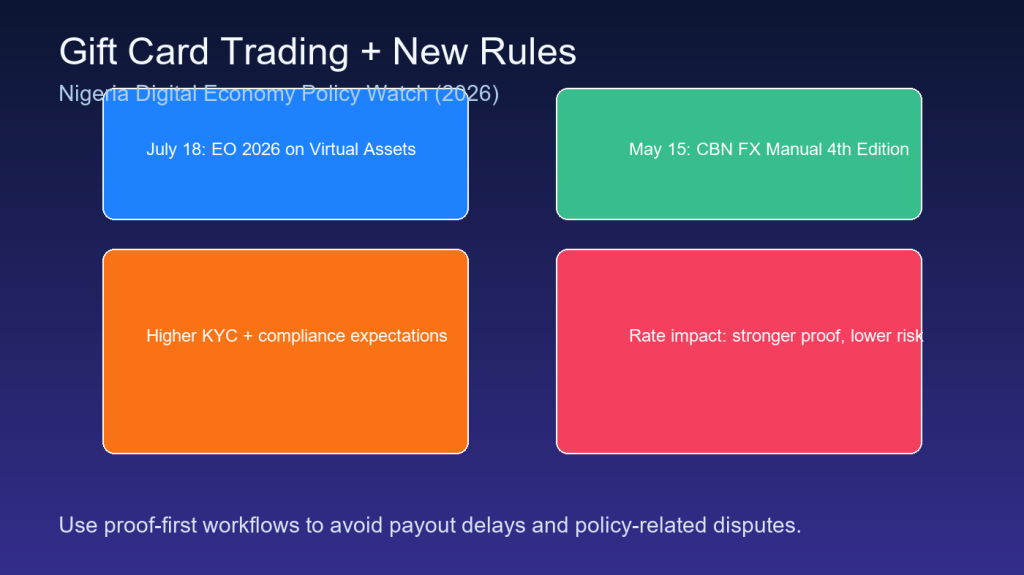
Gift card rates in Nigeria now reflect more than brand demand and denomination.
Nigeria’s Presidential Executive Order on Virtual Assets Coordination, 2026, took effect on July 18, 2026. The order does not set gift card rates; any effect on gift card-platform risk checks would be indirect, through broader expectations for financial oversight, fraud controls, and traceability.
In practical terms, stronger coordination reduces fraud channels, but it also raises review friction for exposed cards.
Clean cards with full proof stay stronger while weak profiles can be priced lower.
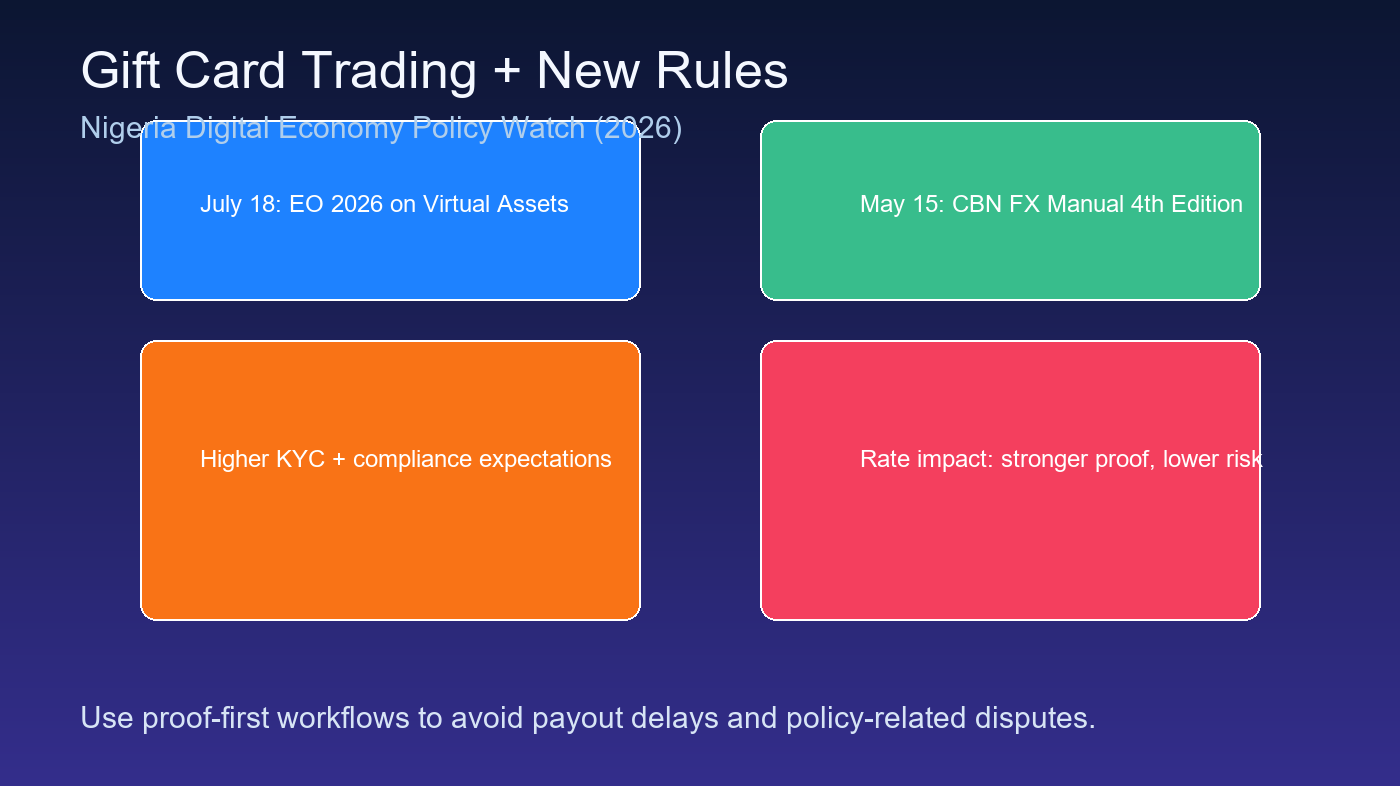
What changed in official policy terms
The Presidential order created a Virtual Asset Council led by CBN with SEC, FIRS, NFIU and ONSA participation.
You can read the official statement here:
PRESIDENT TINUBU SIGNS EXECUTIVE ORDER ON VIRTUAL ASSETS
The practical shift is this: agencies are coordinating reporting, policy, and oversight to reduce opaque channels.
For Nigerian gift card traders, that usually means tighter controls on profiles that are harder to verify.
The CBN reforms page also explains broader directions on payment consumer protection and digital controls:
CBN Reforms and Initiatives
Why this affects your payout rate today
Many traders ask: Why is the first quote not the same as final payout?
This is where policy impact becomes practical.
1) Platform risk pricing can become stricter on exposed profiles
When enforcement pressure increases, platforms often widen the gap between “clean profile” and “high-risk profile” payouts.
Higher-risk profiles often include:
- no-receipt cards (do not treat these as clean-value entries like US Apple)
- high-value cards with unclear origin path
- blurred or partial photos
- inconsistent country or issuer details
- repeated policy flags or unusual account behavior
2) Verification depth can increase
Platforms can require more evidence for high-risk profiles.
What you may notice:
- longer review windows for first-time users and large denominations
- additional proof questions before payout
- different outcomes for similar cards if proof quality differs
3) Rate differences can become more policy-sensitive
You may see variation by:
- brand-country pair
- value tier
- proof quality
- platform review mode (auto vs manual)
News signal and rate decision matrix
| Policy signal | Likely market effect | What to do first | Rate expectation |
|---|---|---|---|
| Stronger agency coordination | Higher scrutiny for weak profiles | Upload full card photos, clear invoice, and card origin details | Lower headline on weak submissions, more stable on clean ones |
| Higher platform anti-fraud awareness | More controls in onboarding | Use official upload flows and support channels only | Wider spread for riskier behavior patterns |
| Manual review growth | Longer processing time on edge cases | Use a low-value test submission before large-card sale | Higher predictability after proof passes checks |
| Country-issuer control tightening | More category-based filtering | Keep country, card type, and denomination exact | Cleaner profile can protect base rate |
Practical flow to protect value
Step 1: Confirm profile details
- Card brand and country pair.
- Card type: physical / e-code / no-receipt.
- Denomination band: $50, $100, $200, $500.
- Proof status and receipt visibility.
- Compare with existing pages before submitting: Steam, Amazon, Google Play, Razer Gold.
Step 2: Compare three independent signals
Use:
- Brand-specific rate page
- Rate Calculator
- Platform trust and payout policy
Do not trust a quote that does not align across all three checkpoints.
Step 3: Set your safety margin
When uncertainty is high, do not sell the full amount at once.
Use a small controlled test first, verify payout behavior, then scale.
Official reporting and risk channels
If a payment or account issue happens, official reporting matters.
- Cyber-related report channel: NPF-NCCC e-report portal
- Keep evidence: screenshot, quote log, card photos, chat export, and transaction ID.
30-day response checklist for every policy change
- Refresh card photos and receipts to full legible resolution.
- Keep one evidence folder per submission.
- Confirm settlement timing before sharing full details.
- Ask for escalation path before trading high-value cards.
- Avoid anonymous buyer-first instructions.
Case study: same brand, different payout band
Two similar physical cards can still settle differently even when brand and denomination look the same.
If one card has clear proof and stable profile history, it can keep a better payout band.
If another has uncertain proof history, review cost rises and payout can drop.
Final payouts follow three variables: active market demand, platform compliance exposure, and verification depth.
FAQ
Will all gift card rates drop after this policy signal?
Not all. Clean profiles usually remain more resilient, while weak profiles are often discounted.
Should I expect slower payouts immediately?
Not always. You may see more variation in review time for certain cards.
How do I minimize payout impact?
Upload clean evidence, submit in correct format, and avoid unknown flow instructions from social-media users.
Is this only about virtual assets?
No. It is about broader financial controls and traceability expectations that can spill into gift card trading.
What is the best first step before high-value listing?
Run a low-value control submission and confirm review quality first.
Bottom line
- Treat policy updates as risk signals
- Improve proof quality before listing
- Test small then scale
- Choose platforms with clear support and payout policies
Today, the best rate is still dynamic, but a clean profile is what helps you keep that rate through verification.