
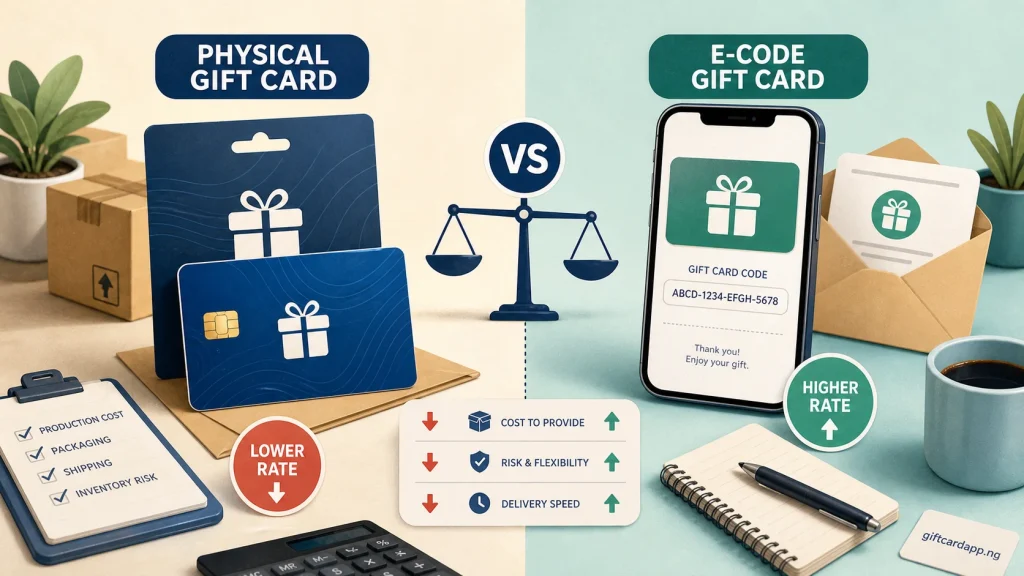
Physical and e-code gift cards can receive different rates because they carry different proof signals. A physical card may come with packaging, card photos, and a receipt. An e-code is easier to send, but the platform may have less evidence about source, ownership, and whether the code has been exposed.
What counts as a physical card?
A physical card is usually a printed card bought from a store or retail channel. For trading, the useful evidence is not only the code. The platform may also look at the card photo, serial area, receipt date, activation line, and whether the image looks edited or incomplete.
What counts as an e-code?
An e-code is a digital code sent by email, app, receipt portal, reward site, or online store. It can be perfectly valid, but it can also be harder to prove if the trader cannot show source details or if screenshots are cropped.
| Format | Good signal | Weak signal | Likely effect |
|---|---|---|---|
| Physical with receipt | Card photo matches receipt and activation proof | Blurred or cropped receipt | Usually stronger estimate |
| E-code | Original email/source visible and region clear | Only copied text or edited screenshot | May receive e-code discount |
| No receipt | Low-value card with clear balance proof | No purchase or activation evidence | Often lower rate or manual review |
| Prepaid card | Official balance proof and no pending holds | Partial use or unclear cardholder details | Higher risk discount |
Why physical can pay more
A clean physical card gives the platform more ways to verify the transaction. If there is a dispute, the receipt and activation proof help explain where the card came from. That reduces uncertainty. Lower uncertainty can become a better quote.
Why e-code can still be strong
Some e-codes are easy to process, especially common gaming cards or digital brands with active demand. For example, Steam or Razer Gold e-codes can move quickly when country, currency, and source are clear. The issue is not “digital is bad”; the issue is whether the platform can verify it confidently.
Which estimate should you use?
Use the physical estimate only if you have physical-card proof. Use the e-code estimate for digital delivery. Use a conservative no-receipt estimate when proof is weak. Mixing these up is one reason users feel “the platform reduced my rate.”
Before submitting either type
- Confirm the brand and country.
- Check whether the platform accepts that card type.
- Keep receipt or source proof ready.
- Do not send the code through public comments or random chat.
- Ask for final payout terms before submission.
Receipt proof guide Calculate payout All rates Calculator Price system Platform list Scam Radar
Official card-format context
Issuer rules differ by product. Apple explains redemption in its official gift card guide, while Google publishes separate country and currency rules.
FAQ
Is physical always better than e-code?
No. Physical often has stronger proof, but some e-codes move quickly when source and region are clear.
Why do no-receipt cards pay less?
The platform carries more uncertainty and may need manual review.
Can I convert an e-code safely?
Yes, if you use a traceable platform and confirm supported region, source proof, and final rate first.
Should I crop card photos?
No. Cropped photos can reduce trust. Hide sensitive data only according to the platform flow.
Common user scenarios
A student may receive an Apple e-code from an overseas friend, while another trader may buy a physical card from a retail store and keep the receipt. The e-code trader has speed, but may need to prove source. The physical-card trader has stronger visible evidence, but still needs clear photos and matching receipt details. Neither card is automatically safe or unsafe; the rate depends on how much confidence the platform can build from the evidence.
What to check before choosing a rate row
Do not choose “physical” just because the brand is valuable. Choose physical only when the card is truly physical and you can support it with original proof. Do not choose “e-code” when you only have a forwarded message with no source. If you cannot prove source, think like a reviewer: would this evidence be enough if the card later failed?