
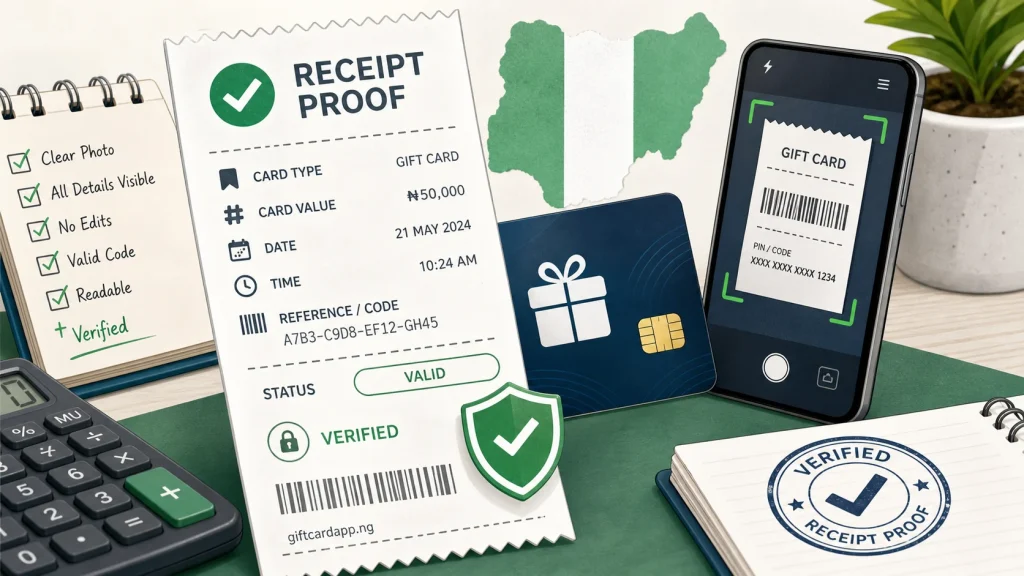
Receipt proof helps a platform understand where a gift card came from and whether it was activated properly. It can improve trust, reduce manual review, and sometimes support a better rate. It does not guarantee payout, but missing proof can reduce the quote.
What good receipt proof includes
| Proof item | Why it matters | Common mistake |
|---|---|---|
| Purchase receipt | Shows date, store and card purchase context | Submitting a cropped receipt |
| Activation line | Shows card was activated at purchase | Photo too blurry to read |
| Card photo | Helps match card and receipt details | Exposing the code outside platform flow |
| Order email | Useful for e-code source proof | Only sending copied text |
| Balance screenshot | Can support prepaid-card review | Showing sensitive details publicly |
Why no-receipt cards are discounted
A no-receipt card may still be real, but the platform has less evidence. If the card later triggers a dispute, the platform may not be able to prove purchase or activation. That uncertainty becomes a discount, a delay, or a rejection.
How receipt affects different cards
Receipt proof is especially important for high-value cards, physical Apple cards, prepaid cards, and cards that often trigger manual review. For small gaming e-codes, source proof and region clarity may matter more than a store receipt, but the same principle applies: the more credible evidence, the better the review confidence.
How to photograph proof
- Use bright light and avoid blur.
- Keep the full receipt visible, including date and activation section.
- Do not post proof publicly.
- Follow the platform's masking instructions for sensitive details.
- Keep original files until payout lands.
When receipt is not enough
A receipt cannot fix a wrong region, an already redeemed card, or a code exposed to another buyer. It is one evidence layer, not a magic guarantee.
Physical vs e-code Vanilla balance check All rates Calculator Price system Platform list Scam Radar
Official proof examples
Proof requirements vary. See Razer Gold Help and Google Play gift card error help for issuer-specific examples.
FAQ
Can I trade without receipt?
Sometimes, but expect lower rate, stricter review or rejection.
Does receipt guarantee payout?
No. It improves evidence but the card still needs to pass brand, region and balance checks.
Should I send receipt to a random vendor?
Avoid sending sensitive proof outside a traceable platform or trusted process.
What if my receipt is faded?
Try to provide the clearest original image and any supporting purchase evidence.
What makes receipt proof convincing
Convincing proof is complete, readable, and consistent. The date should make sense, the activation line should be visible, the store or order source should match the card country, and the card photo should not look edited. A receipt that is cropped to hide important context may create more suspicion than confidence.
How no-receipt affects different users
A user with a small reward card may still find a platform willing to accept no receipt. A user with a high-value physical card may face stricter proof requirements. The same “no receipt” label does not mean the same risk for every brand and amount. This is why the rate calculator should be treated as a planning tool, not a guarantee.
How to talk to support
If a platform asks for proof, send organized evidence: receipt image, card image according to their masking rules, source explanation, and exact card country. Do not argue by saying “the card is real” only. Review teams need evidence they can record and verify.
Receipt proof for e-code users
E-code users may not have a paper receipt, but they can still provide source proof. Useful evidence can include the original email, order page, reward dashboard, invoice, sender details, and visible country or currency. The platform does not need a fancy document; it needs a believable chain showing how the code reached you.
Why edited screenshots are risky
Editing screenshots can remove context that support needs. If you must hide sensitive details, follow the platform's exact masking rule. Over-masking can make a real card look suspicious.