
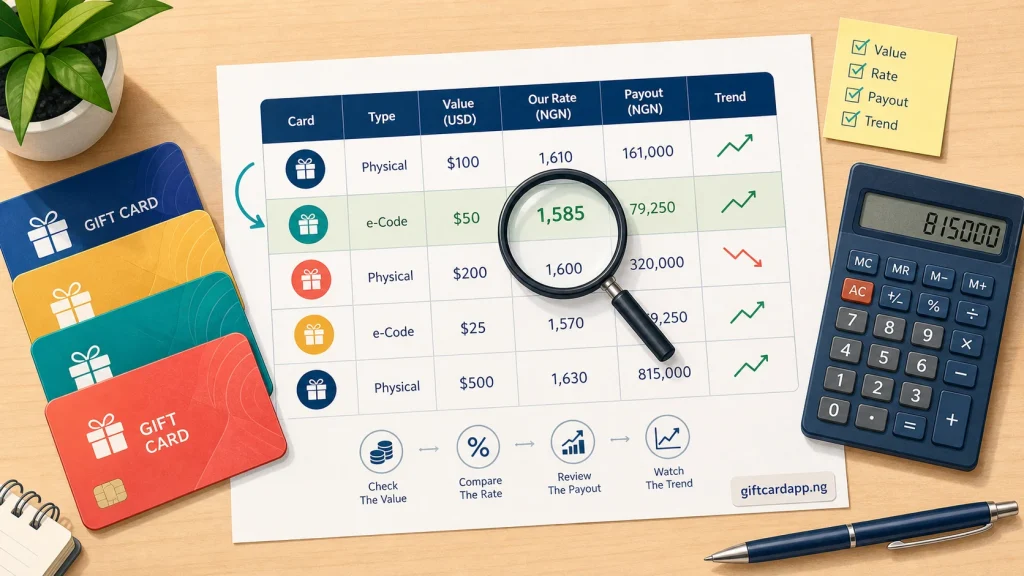
A gift card rate table tells you the estimated Naira value before final platform review. To read it correctly, look at the card brand, country, type, amount, update date, and whether the table separates physical, e-code, and no-receipt rates.
Reviewed reference rates. Collected 2026-10-16 03:22 WAT. Match the face value and every condition. An estimate does not guarantee a payout.
| Card / country | Currency | Card form | Eligible face values | NGN per currency unit | Conditions |
|---|---|---|---|---|---|
| Amazon United Kingdom | GBP | E-code | 50, 100, 200 | ₦804.85 | E-codes · Slow card |
| Amazon United Kingdom | GBP | Physical | 50, 100, 200 | ₦1,046.30 | Physical · Slow card |
| American Express United States | USD | Physical | 100, 200, 500 | ₦201.21 | Clear Picture Required · Only Codes Starting with 3779 · Physical · Single Card Only · Slow card |
| Apple Australia | AUD | Physical · Horizontal | 50, 100, 200, 500 | ₦645.80 | Clear Picture Required · Fast card · Horizontal Cards Only · Physical |
What each table column means
| Column | What it means | How to avoid mistakes |
|---|---|---|
| Gift card | Brand and sometimes country, such as US Apple or UK Amazon | Do not assume all countries pay the same |
| Type | Physical, e-code, no receipt, prepaid, or clean card | Choose the row that matches your exact card |
| Rate | Estimated Naira per $1 | Multiply by USD amount for planning |
| Payout | Estimated total value for a card amount | Treat it as a range, not a guarantee |
| Updated | When the table was reviewed or synced | Prefer recent updates for volatile cards |
Example calculation
Hypothetical example only: for a US-issued USD 100 card, a buyer quote of ₦1,000 NGN per USD 1 gives ₦100,000 NGN gross. If the buyer discloses a total fee of ₦2,000 NGN, the estimated net amount is ₦98,000 NGN. These are invented teaching inputs, not observed market rates. A missing receipt does not justify applying a fixed percentage discount: ask whether the buyer accepts that exact card and request its actual net NGN quote.
Why tables should show ranges
A single number looks neat but hides reality. A clean Apple physical card, Apple e-code, and Apple card without receipt can all produce different outcomes. Tables that show low, middle, and high values help users plan without being surprised by review discounts.
Red flags in bad rate tables
- No last-updated date.
- No separation between physical and e-code.
- No mention of receipt or region.
- No safety warning about final platform review.
- Rates that look far higher than every other source.
How to use a table before selling
- Identify brand and country.
- Choose the right card condition.
- Calculate your amount.
- Open the related card page for risk notes.
- Compare platform options before sending details.
$100 value guide Small vs large cards All rates Calculator Price system Platform list Scam Radar
FAQ
Is the table payout guaranteed?
No. The platform sets final payout after reviewing the card.
Why does update date matter?
Gift card demand and risk can change quickly, so old tables may mislead users.
What if my card is not listed?
Use a related brand as a rough benchmark, then confirm inside a platform that supports the exact card.
Should I use the highest row?
Only if your card condition matches that row. Otherwise use a conservative estimate.
A good table should answer the next question
Many users arrive with one question: “How much will I get?” A weak table answers only that. A useful table answers the follow-up questions too: what card type is this, when was it updated, does receipt matter, what happens if the card is e-code, and where should I check risk before submitting? Those extra details are what turn a rate table into a decision tool.
How to avoid overestimating your payout
Start from the middle estimate, then adjust down if your card has no receipt, unclear source, unusual region, high value, or previous redeem error. Traders often feel disappointed because they calculate with the strongest clean-card rate even when their card is not a clean-card case. The table is not wrong; the row selection is wrong.
Reader habit to build
Before each trade, read the table from left to right: brand, type, condition, amount, updated date, and warning. That habit prevents most overestimation mistakes.