
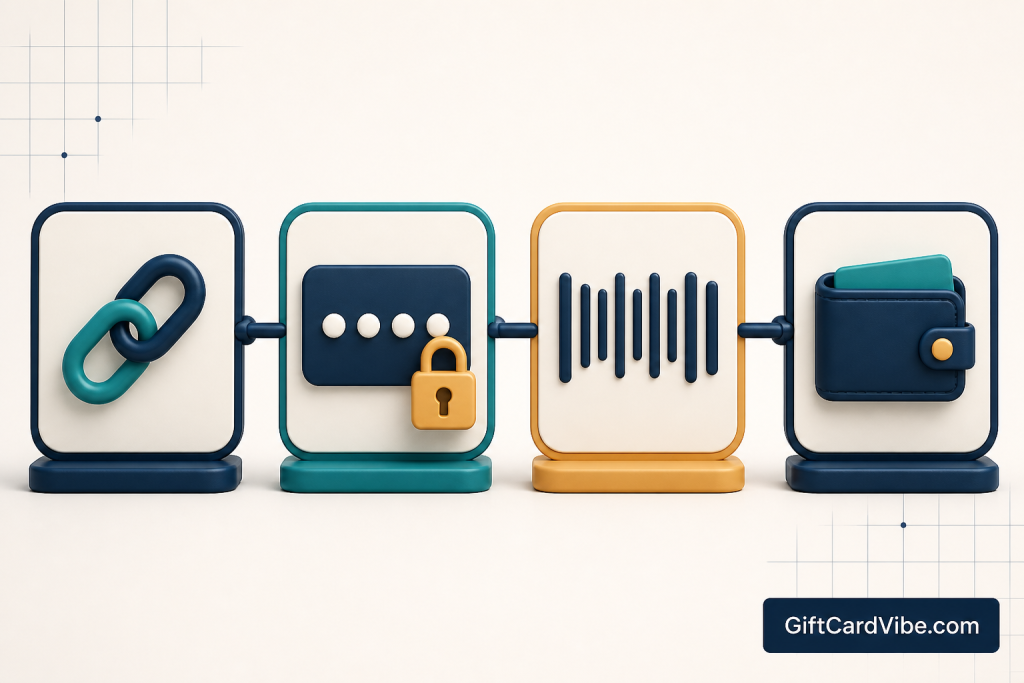
A gift-card link is a route to view or claim a gift; a code is the credential used to redeem value; a barcode may identify a card or enable scanning; and a redeemed balance is value already attached to an account. They are not interchangeable, and opening or redeeming the wrong item can change whether it is transferable.
The four formats at a glance
| Format | Typical purpose | Main risk |
|---|---|---|
| Gift link | Opens a page to view or claim a gift | Forwarding may give access to another person |
| Claim or redeem code | Adds value to a store/account | Anyone with it may redeem first |
| Barcode or QR | Identifies or scans a card | Can contain sensitive card data |
| Account balance | Spendable value after redemption | Often cannot be transferred back into a code |
The email or message around a link is not proof of current value. A link may have been opened, replaced, cancelled, scheduled, or redeemed.
Before opening a link
Check the sender through a channel you already trust. Then inspect the domain without signing in through a shortened or misspelled URL. A legitimate brand message can still be forwarded by an attacker, and a convincing logo does not make a link safe.
If you were not expecting the gift, do not enter your email password, bank details, one-time code, or recovery phrase. Official gift redemption should not require remote screen access.
Opening is not always redeeming—but do not guess
Some links display a gift before a separate redeem step; others may claim it quickly. Read the issuer’s current instructions. Apple says an emailed gift can be redeemed from the email’s redeem control, while Google Play describes digital cards delivered by email, SMS, or shareable link in supported locations.
If you plan to trade the card, ask the platform which state it accepts before clicking. Once value enters your personal account, it may become non-transferable account balance.
What a buyer actually needs to know
A clear description includes:
- issuing brand and country;
- original denomination;
- delivery form: email, SMS, link, or plain code;
- whether the link was opened;
- whether the value was redeemed to any account;
- order or receipt evidence available;
- current official status, if the issuer provides one.
Do not call an opened link “unused” unless the issuer confirms the claim status. Do not send the live credential merely because a buyer says it must “test” it outside an order.
If you already forwarded the link
Assume another person may have access. Contact the purchaser and issuer promptly through official support, preserve the original order record, and avoid clicking repeatedly. If value was taken, follow the issuer’s fraud-reporting process. The FTC warns that sharing card numbers or photos can allow scammers to spend the funds.
Our PIN, serial number and barcode guide explains the identifiers in more depth. For platform checks, use The Legit List before entering any authenticated trade flow.
Bottom line
Identify the asset before interacting with it. A delivery link, redeem code, barcode, and redeemed wallet balance carry different evidence and transfer rules. Keep the live credential private until the issuer’s or a verified platform’s protected flow requires it.