
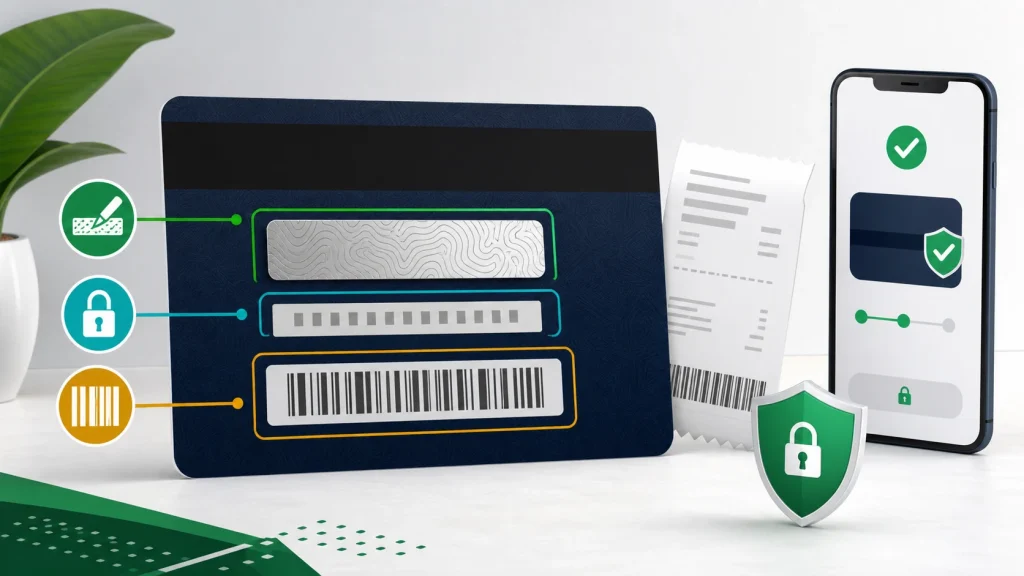
A gift card PIN or redemption code is the secret that can move the card’s value into an account. A serial number identifies the physical card, while a barcode usually helps a retailer or issuer track the product and activation record. They can appear close together, but they are not interchangeable. Before trading a card in Nigeria, protect the redemption code, keep the receipt, and share card images only through the verified order process you have chosen.
The four details people commonly confuse
The back of a physical gift card can look like a collection of numbers, boxes, and stripes. Each element has a different job. The safest approach is to identify the element before photographing or sharing it.
| Card detail | What it usually does | Can it spend the value? | Safer handling |
|---|---|---|---|
| PIN or redemption code | Claims the card balance inside the issuer’s account or store | Yes, in most gift card systems | Keep covered until you deliberately submit a trade through a verified order |
| Serial number | Identifies a particular card for issuer, retailer, or support records | Usually no | Do not publish it; provide it to official support when a case requires it |
| Barcode | May encode a product, serial, activation, or point-of-sale reference | Not by itself in most systems | Cover it in public photos because the encoded data varies by issuer |
| Receipt or activation slip | Shows where and when the card was purchased and may show activation | No | Keep the full original; redact payment and personal details from non-support copies |
PIN, claim code, and redemption code mean nearly the same risk
Issuers use different words for the credential that unlocks value. Apple calls it a redemption code, Amazon commonly uses claim code, Steam uses Wallet Code, and other cards may simply print PIN. The format may be letters, numbers, or both. The security rule is the same: whoever can successfully redeem that credential may control the balance.
A scratch-off panel is a physical privacy seal, not a guarantee that the card is funded. The retailer normally activates a physical card at the point of sale. A card can therefore have an untouched scratch panel and still be unactivated if the checkout process failed. The reverse is also true: an exposed panel does not prove that the code has been redeemed, although it increases the risk and can reduce what a trading platform is willing to pay.
What a serial number can and cannot prove
A serial number helps distinguish one card from another in the issuer’s system. It can be useful when a redemption code is damaged, when the retailer needs to trace activation, or when official support investigates a problem. It is not normally the credential used to claim the balance.
Apple’s support guidance makes this distinction explicit: the card serial number is different from the redemption code. Apple may ask for the full front and back of the card, the purchase receipt, and the serial number during a support case. Google Play similarly says that an unreadable-code investigation may require a photo of the card back with the serial number visible plus the receipt.
That does not make a serial number harmless. Publicly posting it can expose part of the evidence that official support uses to identify a card. A scammer may combine it with a copied receipt, social-engineering story, or other images. Treat it as supporting evidence: less sensitive than the redemption code, but not something to publish without a reason.
A barcode is not a universal balance checker
Barcodes are designed for machines, but the information inside them is not standardized across every gift card brand. One barcode may represent a product type, another may include a serial reference, and another may support point-of-sale activation. Scanning a barcode with a phone does not reliably prove that a card is active, unused, or worth the amount printed on the front.
This is why a screenshot saying “barcode scanned” is weak trading evidence. Activation status comes from the issuer or retailer record. Unused status depends on whether the secret code has already been claimed. Balance information should be checked only through the issuer’s official process, if the brand offers one.
Why a receipt matters even though it is not a code
A receipt connects the card to a purchase event. For a physical card, it may show the retailer, date, denomination, card suffix, and activation result. Those details can help official support or a trading platform investigate a mismatch. They can also influence a platform’s risk assessment, especially for a high-value or unsealed card.
A receipt does not prove that the code remains unused after purchase. Someone could photograph the code and still hold the receipt. It also does not override a country restriction. Think of the receipt as provenance evidence, not as ownership of the balance.
Keep the original image uncropped in your private records. When showing a preliminary copy, hide payment-card digits, loyalty numbers, customer names, QR codes, and unrelated purchases. Official support may later request an unedited version through its own secure channel.
A safer photo workflow before trading
- Photograph the card and receipt for your private records. Use good lighting and capture the full edges. Do not send these originals yet.
- Identify the brand, issuing country, denomination, and format. These affect whether a Nigerian platform accepts the card and which price row applies.
- Compare the card through a normal website or app interface. Start with the gift card rate directory and review the card’s country-specific page before creating an order.
- Choose the platform before exposing the code. Compare published criteria on The Legit List. Do not let a private buyer decide the process after seeing your card.
- Create a traceable order. Confirm the final Naira quote, card type, receipt rule, and support route. Then follow only the instructions inside that order.
- Keep every record until payout is settled. Save the order ID, quoted amount, submission time, status changes, support messages, and bank credit record.
If the card is already scratched, read the separate guide to trading an unsealed physical gift card. If the code arrived by email, use the e-code versus physical-card guide because an email order number, delivery link, and redemption code create different exposure risks.
What legitimate support may ask you to show
Context matters more than the request alone. Steam’s official Wallet support says that when a retail Wallet Code still fails after several hours, support may request a clear image of the entire back of the card and a matching retail receipt. Apple and Google Play publish similar evidence requirements for certain damaged or unreadable-code cases.
The key difference is destination. Sending a full card image through the issuer’s official support flow is not the same as sending it to a person who contacted you on social media. Before uploading evidence, begin from the issuer’s official website or app, check the domain, and record the case number.
A trading platform may also need the code to complete a sale. Submit it only after you intentionally create an order and understand who operates the platform. The warning is not “never share a code under any circumstance”; it is “never reveal the value credential before you have chosen and verified the transaction channel.”
Physical cards and e-codes expose different identifiers
An e-code email can contain several items: the redemption code, order number, recipient email, delivery link, purchase timestamp, and sometimes a receipt attachment. The order number helps the seller or issuer trace the purchase, while the redemption code controls the value. A shareable gift link may itself reveal the code after one click, so treat the link like the code.
Forwarding the entire email is often unnecessary and may expose personal data. Save the original, then provide only the fields the verified order requires. Never post an e-code screenshot in a group while asking whether it is valid; even a partly cropped image may leave enough characters or a scannable link visible.
Three myths that cause avoidable losses
“The barcode shows the balance”
Not reliably. A barcode reader can display encoded characters, but only the issuer’s system can interpret them and report a trusted status.
“An intact scratch panel means the card is active”
No. Activation normally happens at purchase. A checkout error can leave an untouched card without usable value.
“A serial number is safe to post because it cannot redeem the card”
It is less sensitive than the code, but it can still be part of a support claim or social-engineering attempt. Share it only when there is a clear operational reason.
If you accidentally exposed a code
Stop forwarding the image and preserve the message history. Use the issuer’s official balance or support process immediately. If the code is still unused, do not test it across random websites or multiple buyer apps; a “test” can become a redemption. If the card has already been taken, collect the receipt, original card images, timestamps, usernames, phone numbers, and transaction records before contacting the issuer and the platform involved.
For a broader response plan, read what to do after a gift card is taken in a scam. No recovery method is guaranteed, but fast, organized evidence gives an issuer or platform a clearer case to review.
Official sources checked
- Apple Support: If you cannot redeem an Apple gift card
- Apple Support: About gift card scams
- Google Play Help: Fix problems with gift cards and codes
- Google Play Help: Redeem a gift card or gift code
- Steam Support: Steam Wallet and retail Wallet Codes
Quick questions
Is a gift card serial number the same as the PIN?
No. The serial number identifies the card, while the PIN, claim code, or redemption code is normally the credential that claims its value.
Can someone steal a gift card using only its barcode?
A barcode alone usually cannot redeem the balance, but its data varies by issuer and may support a fraudulent claim when combined with other evidence. Do not publish it.
What should I cover in a gift card photo?
For any public or preliminary image, cover the redemption code, PIN, barcode, serial number, QR code, receipt payment details, and personal information. Reveal only what an official support case or verified trading order specifically requires.